
I’m sure there are many skeptical viewers out there who roll their eyes whenever I post speculative “connections” like my last one (or this one from 2011), so today I’ve decided to post a connection that the artist himself has said was deliberate. Take a look, and perhaps ask yourself if you would have noticed Jeff Wall’s formal references to Delacroix’s Death of Sardanapalus (1827) if the connection hadn’t been pointed out to you:
[CLICK IMAGES TO ENLARGE]

ABOVE: Eugène Delacroix, Death of Sardanapalus (1827), oil on canvas, 496 x 392 cm. Via RCN.
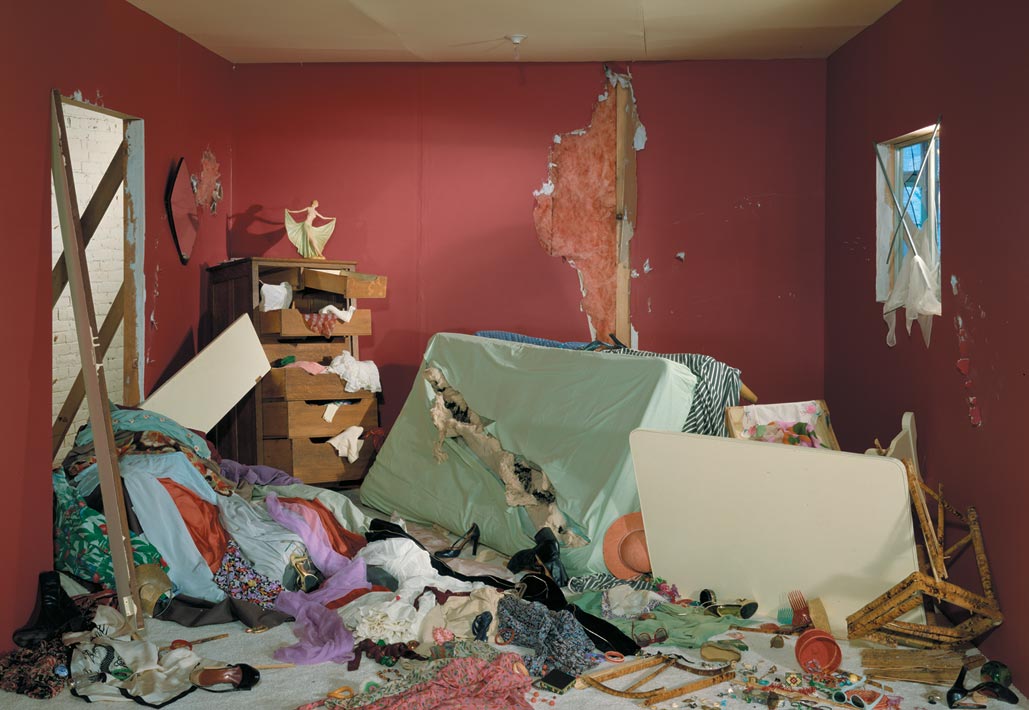
ABOVE: Jeff Wall, The Destroyed Room (1978), transparency in lightbox, 234 x 159.1 cm. Collection of National Gallery of Canada. Via MoMA.
Here’s how Wall interprets his own work:
[…] When I made The Destroyed Room, I worked in reference to the design of commercial window displays of clothing and furniture. I think of these as tableaux morts as opposed to tableau vivants. At the time, they had become very violent, mainly because of an influence from the punk phenomenon which was quickly filtering into the whole cultural economy. At the same time, the picture’s subject matter had something to do with aggression, violence, and revenge in domestic life. I was very interested in Delacroix’s Death of Sardanapalus, partly because I was lecturing on Romanticism. I think the Sardanapalus is a very important picture, historically and psychologically, because it shows the eroticized ideal of military glory which characterized the Napoleonic period being turned inward, back toward domestic life at the end of that epoch, at the beginning of the modern, bourgeois, neurotic private life. This painting interested me as a kind of crystal. My subject was made with this crystal, by passing my ideas and feelings through the historical prism of another work. I felt that this made the subject richer, more suggestive, more aggressive. It was important to filter The Destroyed Room through this other picture because I think I was trying to establish a space for myself by suggesting which historical directions and problems were important to me.
I know that in some ways this is a very artificial way of going about things, very manneristic even, but it was a way to begin, and I had to begin.
[SOURCE: “Typology, Luminescence, Freedom: Selections from a Conversation with Jeff Wall,” in Jeff Wall. Selected Essays and Interviews (New York, NY: The Museum of Modern Art, 2007), pp. 186-87.]
And:
In The Destroyed Room, I was interested in a “remaking” of an existing image, a sort of mannerist attitude toward it. The Delacroix painting seemed very modern to me. I see a lot of so-called “old” art that way. Why shouldn’t we be able to relate to it as contemporary? […]
I was particularly interested in violence at that time, for whatever reason. I was teaching at the university, concentrating on the earlier part of the nineteenth century, and got intrigued by the way that monumental paintings — Delacroix’s preeminent among them — wove together themes of war and military glory, on the one hand, and the conflicts of private life on the other. The intertwining of these two spheres is almost emblematic of that whole period.
[SOURCE: “A Democratic, a Bourgeois Traditon of Art: A Conversation with Jeff Wall by Anne-Marie Bonnet and Rainer Metzger,” in Jeff Wall. Selected Essays and Interviews (New York, NY: The Museum of Modern Art, 2007), p. 246.]
In other words, and in short, not every connection between two works of art is what comic-book guys would dismiss as a swipe.





 Ragged Claws Network


