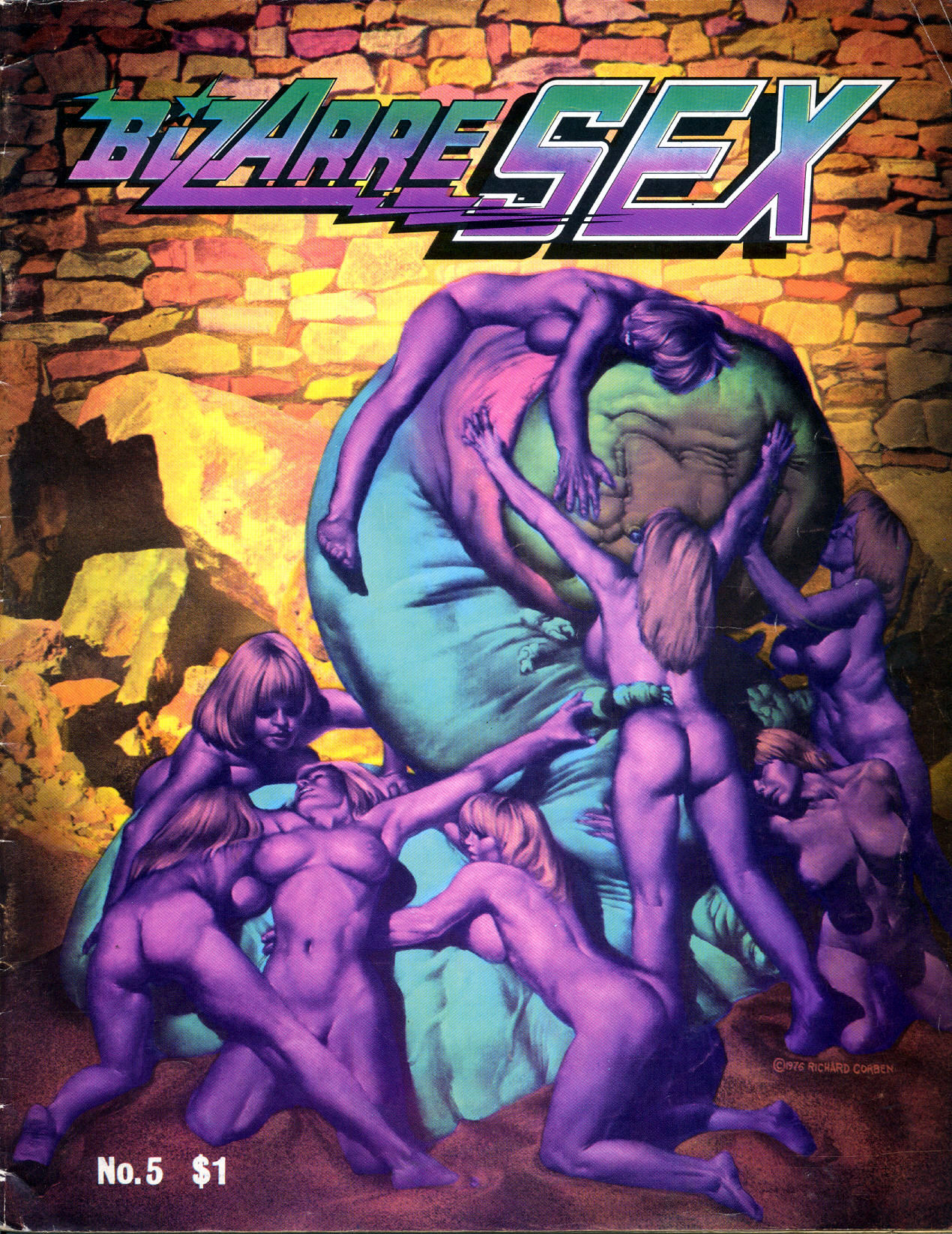
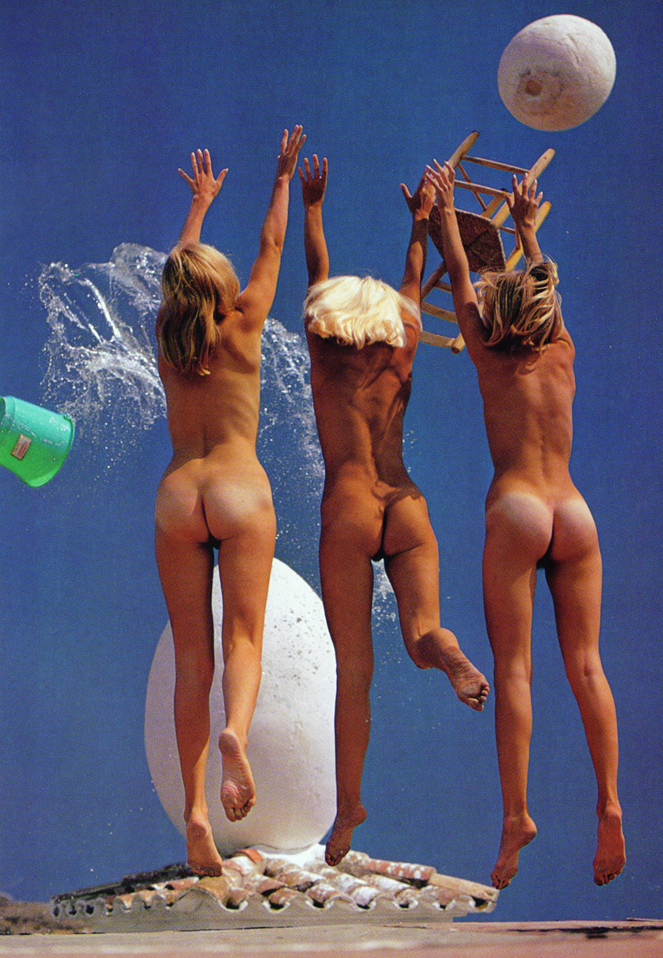
NSFW, obviously…

"This day's experience, set in order, none of it left ragged or lying about, all of it gathered in like treasure and finished with, set aside." –Alice Munro, "What is Remembered"
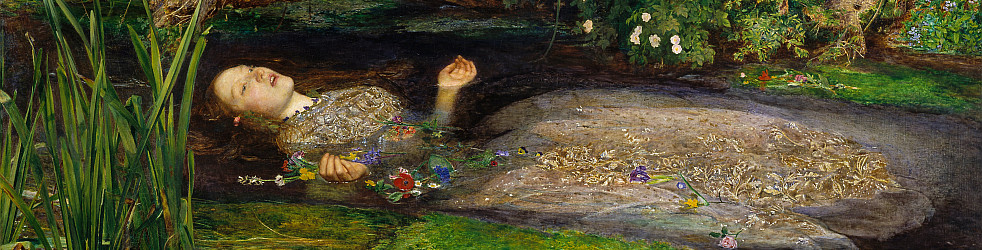
NSFW, obviously…
Freshly scanned from the collection of yours truly, here’s one of Paul Lehr’s best covers with a close-up shot of a human being, which may seem like I’m damning it with faint praise, since most of Lehr’s classic covers are populated with tiny figures dwarfed by technological wonders, strange lands, alien life forms, the cosmos itself, but that is simply not the case. So let me say it plainly: Crompton Divided is one of Lehr’s best covers, period:
[CLICK IMAGES TO ENLARGE]

To view all of the covers with art by Paul Lehr that I’ve posted over the years, start here and click back through the (p)ages. I think you’ll like what you find there.
BONUS IMAGE:
Nice colour here; subject matter is a bit underdeveloped, like concept art for an animated movie, but it’s evocative enough, I guess:
I recently spent a few minutes over at the Grand Comics Database flipping through the database entries for the first hundred issues of Superman’s Girl Friend Lois Lane, looking for covers that might provide context for a comment regarding “the ‘unintentional’ surrealism of […] Silver Age Superman comics.” I rather hastily decided upon one cover from the Lois Lane series, and posted it along with two covers, which I had found by other means, from the run of Superman that began in 1939:
[CLICK IMAGES TO ENLARGE]
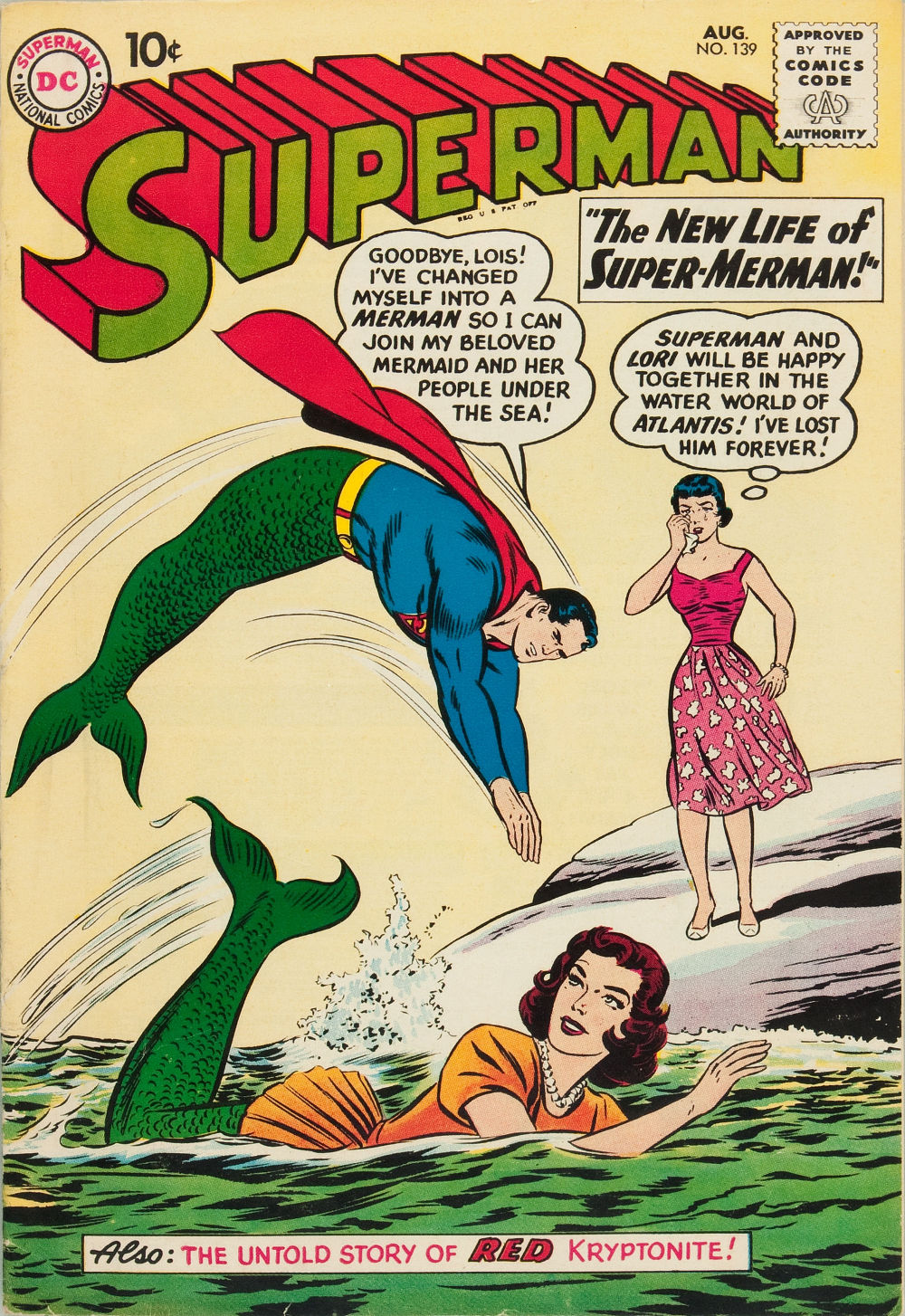
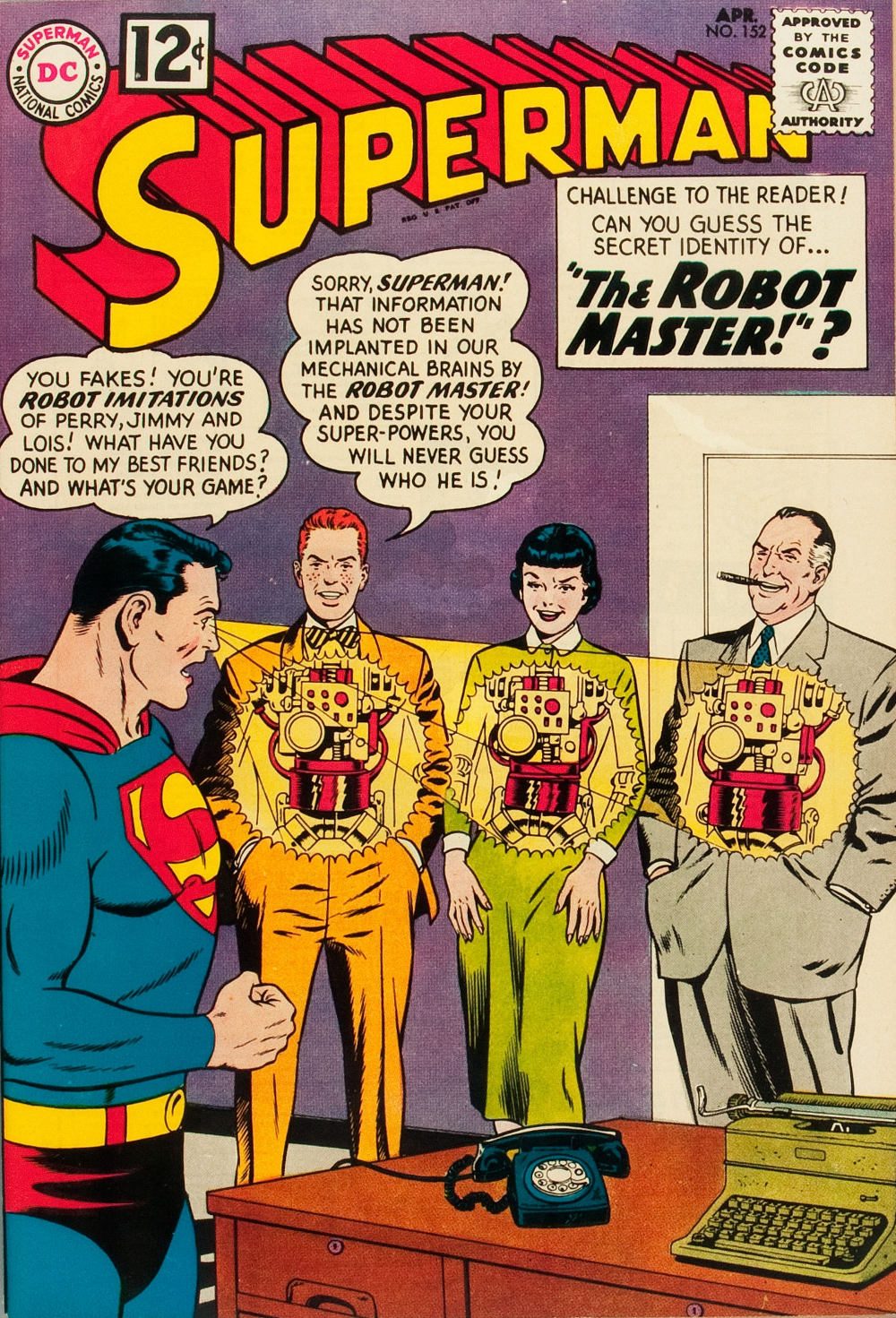
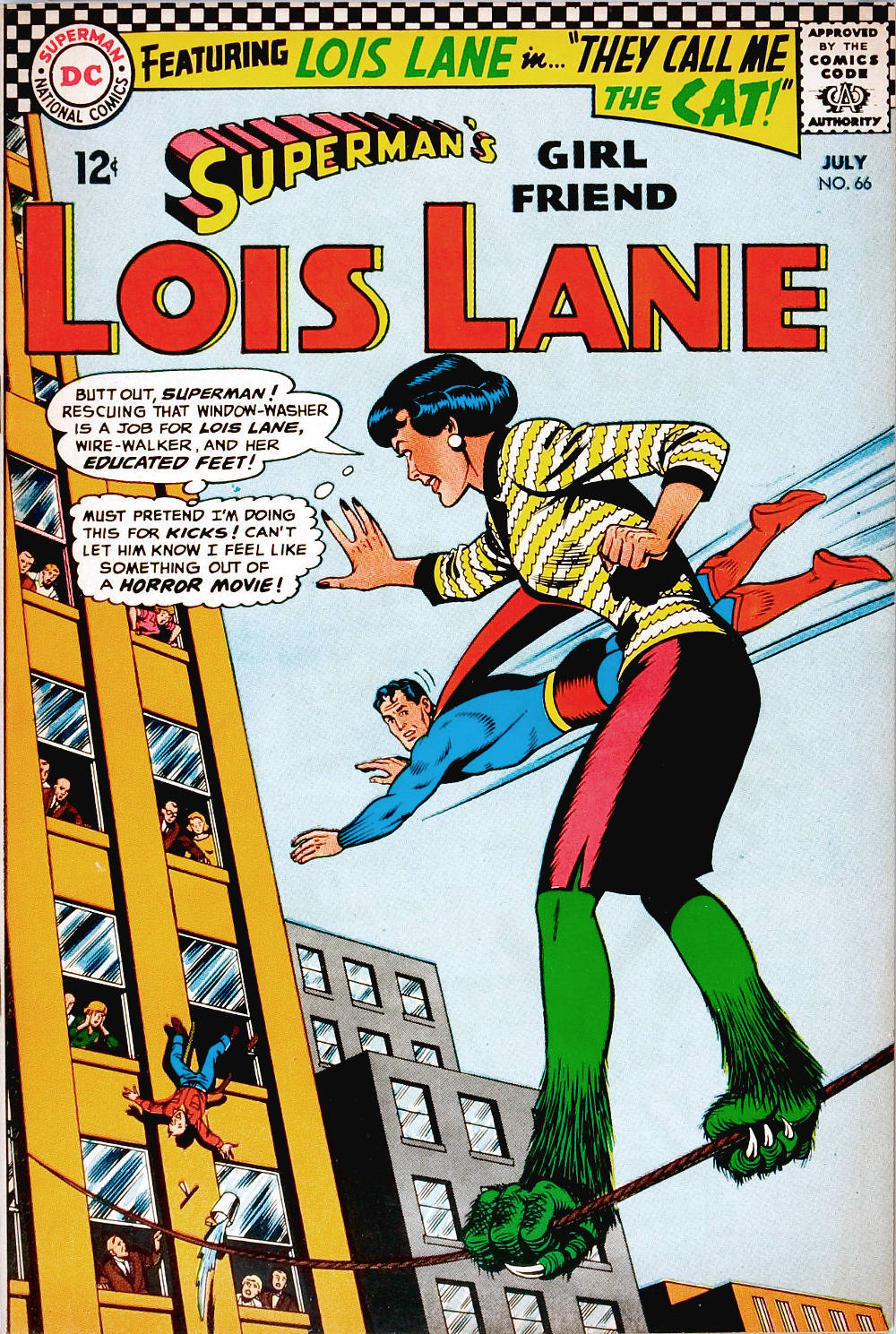
However, truth be told, the Lois Lane covers that really stood out for me in those first hundred issues were these three, with pencils by Curt Swan and inks by Stan Kaye (according to GCD):
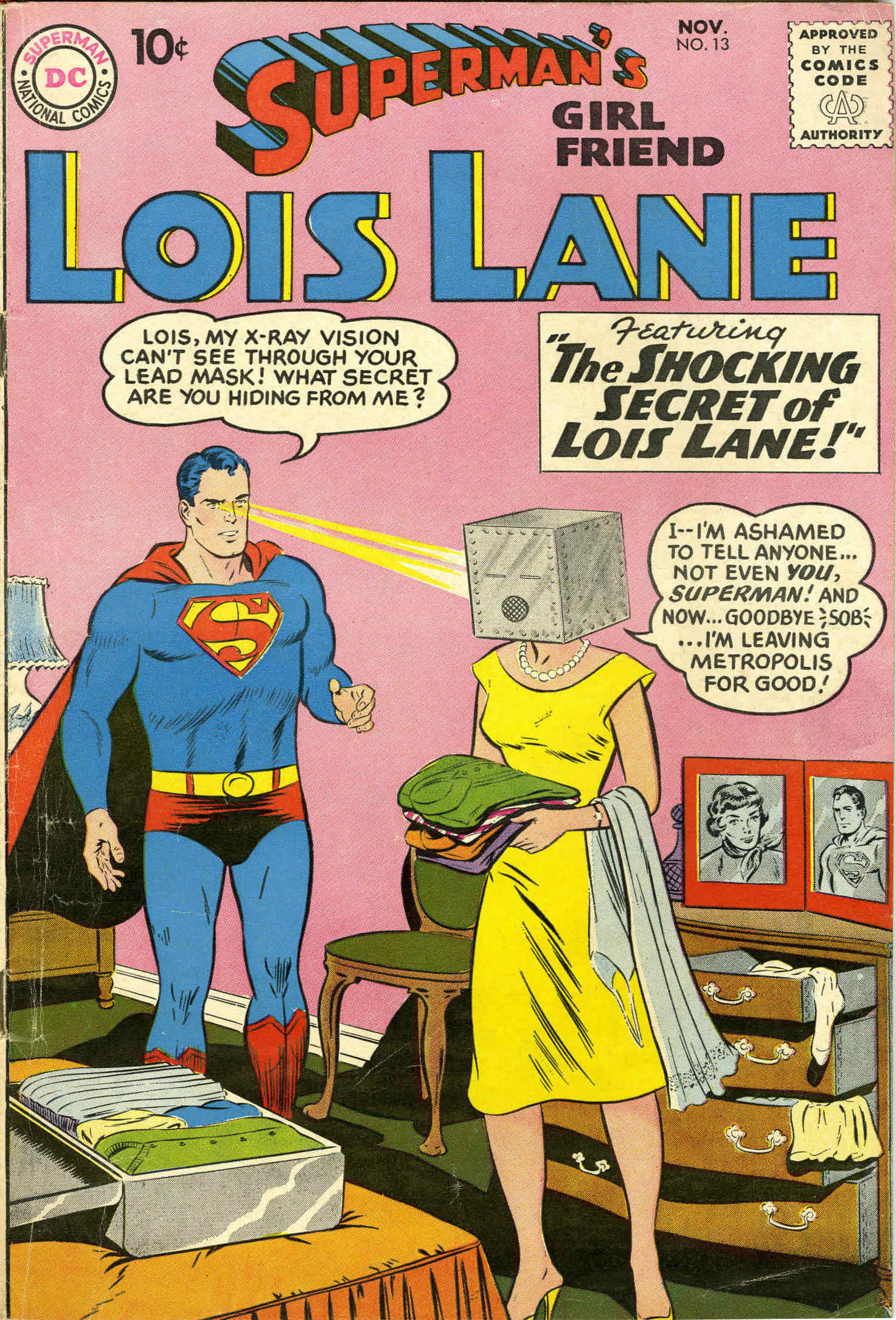

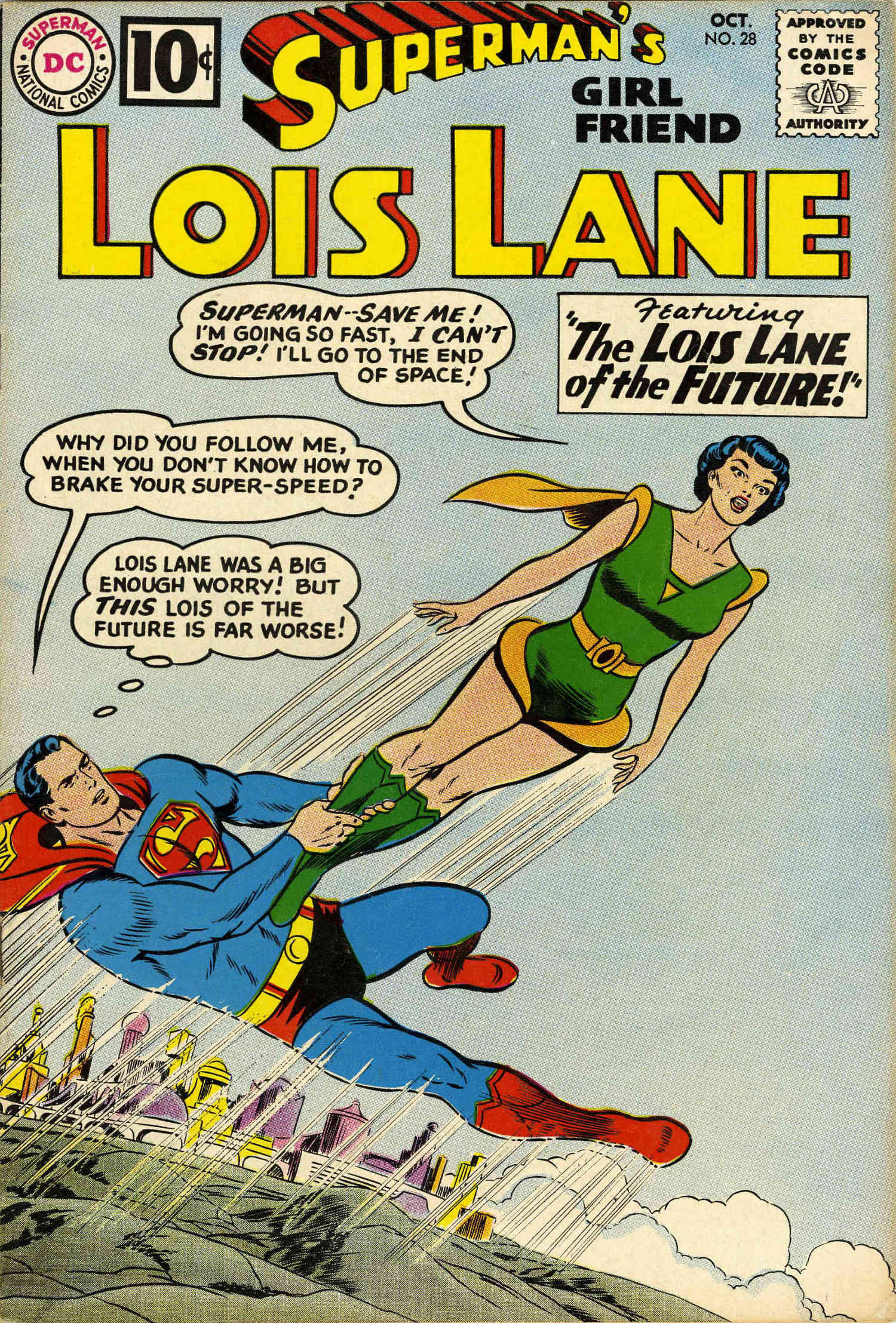
They aren’t the most amusing or surreal or just plain odd Lois Lane covers, and they’re not the best drawn or the most flashy, but they have specific conceptual, emotional, and even aesthetic qualities — simplicity and restraint, for instance — that I appreciate. Thirteen casts Lois Lane as the woman in the lead mask — but unlike Dumas’ man in the iron mask, Lois’s imprisonment, which is both heartbreaking and ridiculously over the top, is not imposed on her but is her own self-punishment! I also find it amusing that, in the same way that she has already packed up her head in a grey box, Lois is packing a grey suitcase to leave Metropolis “for good” as she rebuffs Superman’s question, “What secret are you hiding from me?” Sixteen combines the notion that the beloved has a sort of hypnotic attraction for the one who loves him or her — “You’re just too good to be true/Can’t take my eyes off of you.” — with the old idea that “you always hurt the one you love.” And although Superman’s situation is desperate, I can’t help but laugh when he says, “Lois… take your eyes off me… go far away… you’ve become a menace to my life.” And finally, twenty eight, the most conventionally exciting of the three, nicely conveys the simultaneous feelings of horror, expectation, and even enchantment, that accompany any human journey into the unknown, and it does so through the contrast, intentional or not, between Lois’s frenzied exclamations — “Superman — Save me! I’m going too fast. I can’t stop! I’ll go to the end of space!” — and the frozen, wide-eyed intensity of the expression on her face! And again, Superman provides a bit of deadpan comic commentary: “Why did you follow me, when you didn’t know how to brake your super-speed?”
Even the “large” images at GCD are small — which is the main reason why the images posted above are not from GCD — but if you start here, you can easily flip through all 137 issues of Superman’s Girl Friend Lois Lane and choose your own favourites. For your browsing convenience, each page includes “Next Issue” and “Previous Issue” links, where applicable. Enjoy!
[CLICK IMAGES TO ENLARGE]
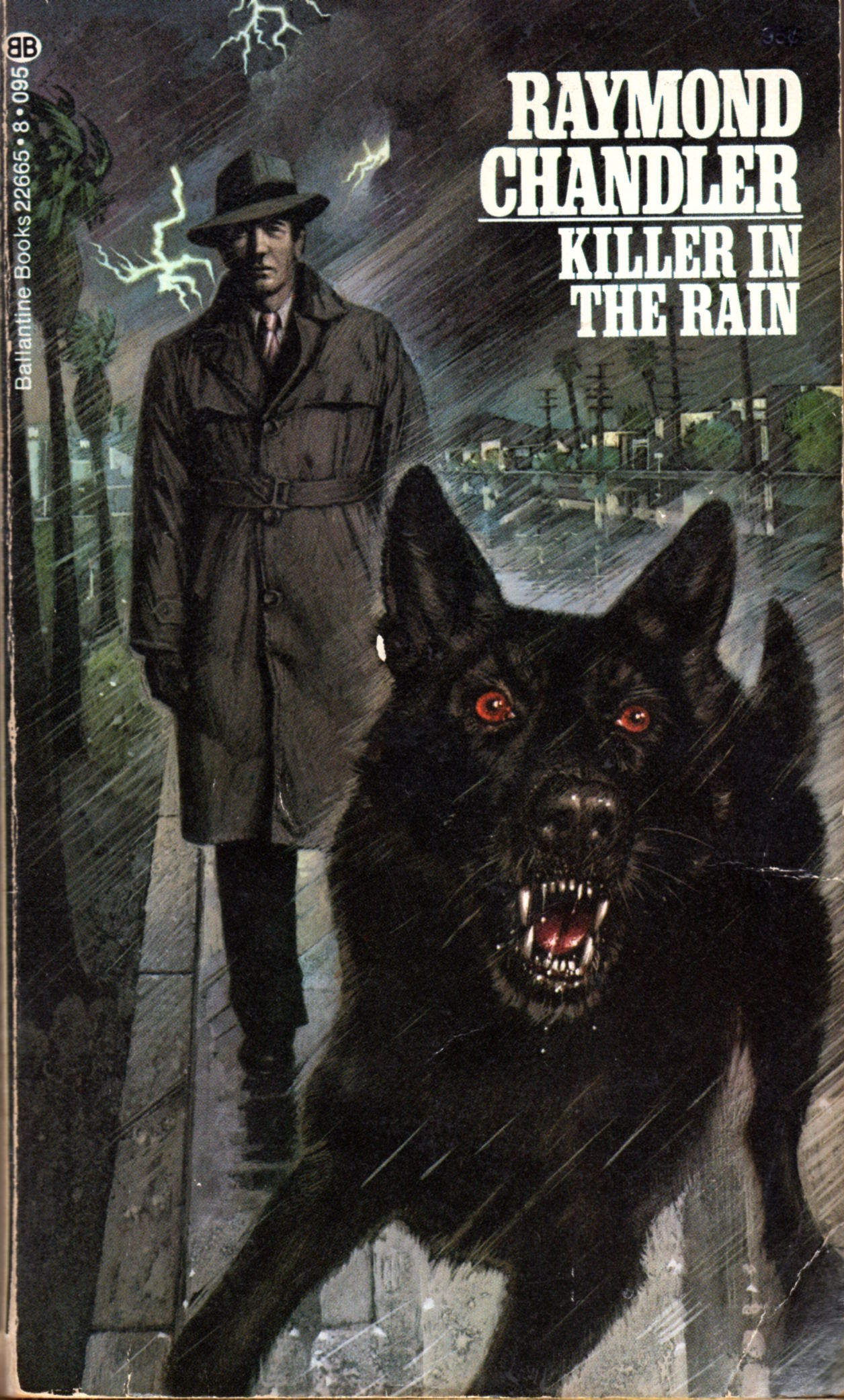
ABOVE: Raymond Chandler, Killer in the Rain (NY: Ballantine, 1973), with cover art by Tom Adams.

ABOVE: Agatha Christie, A Holiday for Murder (NY: Bantam, 1985), with cover art by Tom Adams.
To view all of the paperback covers with art by Tom Adams that I’ve scanned and uploaded for display so far, start here. To view only the other Chandlers, click here.
In my recent conversation with Jeffrey Meyer, which I hope you have read and enjoyed, the artist tentatively but astutely suggests that Boards of Canada’s music “might be a good reference point” for understanding the conceptual basis of his own “Nostalgia” series of collages, which he described to me as “a conscious attempt to deal with that [nostalgia] in an abstract way, with as little traditional imagery or ‘things’ in the final pieces as possible.” Practically speaking, however, one might ask: what, specifically, are Meyer and Boards of Canada nostalgic for? What are the visual and auditory sources that each is re- and dis- and re-membering? An integrated and compelling answer to such questions is beyond the scope of this blog post, and perhaps even beyond my ability to formulate, but the covers of these three editions of Brian Aldiss’s Barefoot in the Head — especially the first American hardcover edition (Garden City, NY: Doubleday, 1970), with photo-based art by acclaimed illustrator and educator James McMullan, who was only 35 or 36 years old at the time — suddenly seem to me, as I sit here at the keyboard this morning typing these words, like they might be portals to the inner sanctum, keys to the heart’s desire…
[CLICK IMAGES TO ENLARGE]
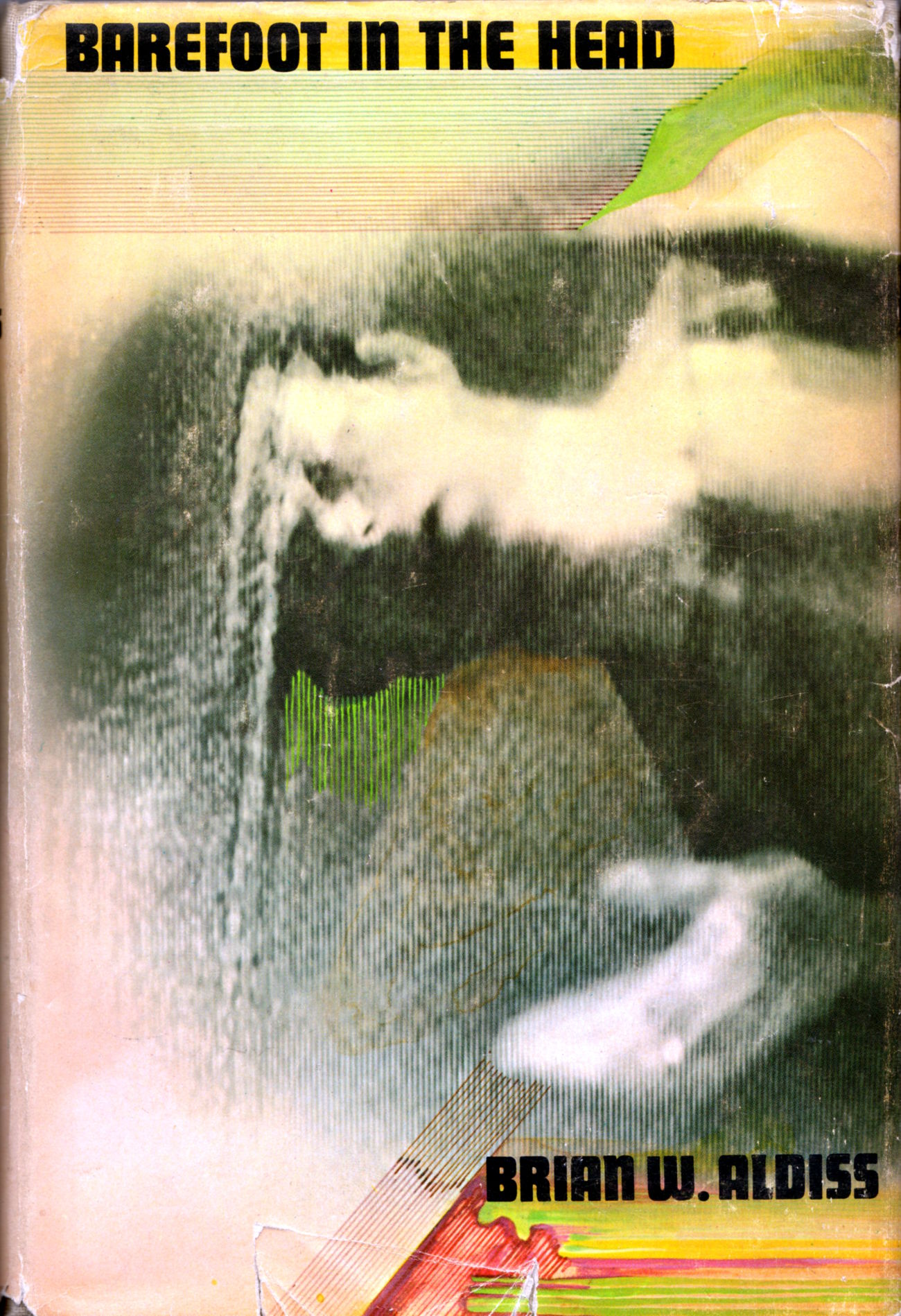
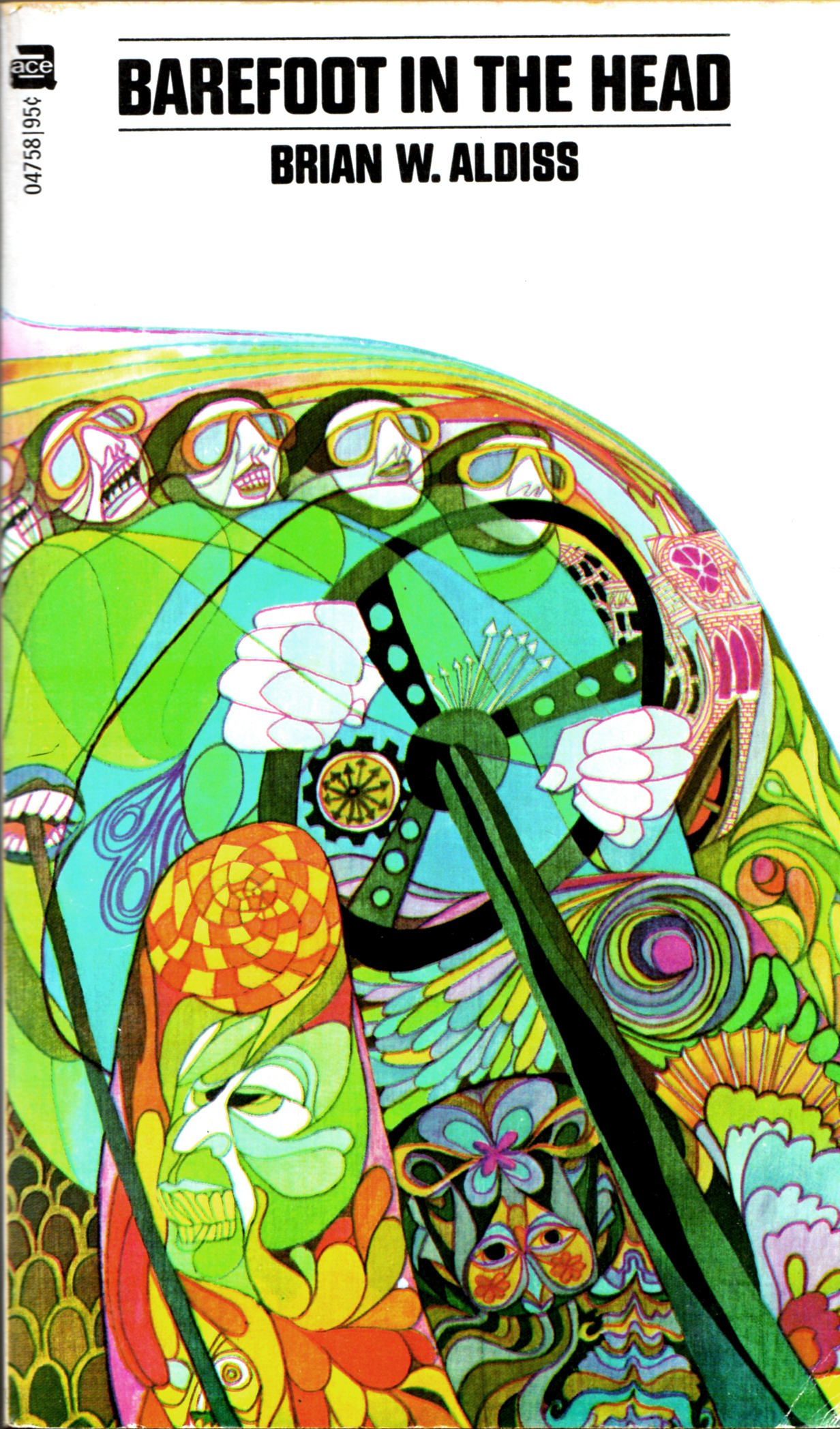

How did I end up with three different editions of Brian Aldiss’s Barefoot in the Head in my book collection? And will I buy more if I stumble across other editions in the future? You don’t wanna know, not because the answers are so outlandish, but because they’re so mundane.
P.S. Okay, okay… I’m done promoting RCN talks with collage artist Jeffrey Meyer now. In my next post, RCN will return to its regular programming.
LESSON OF THE WEEK THAT IS:
My most popular tweet to date isn’t about art or music or bacon or anything else that really matters to me; it’s a throwaway line about 3D printers. Here’s a screen shot:

I’m so proud.
P.S. I have a habit, on this blog, of referring to any illustrator (or writer) whose work I have decided to highlight who has not received formal credit for his or her work, and whose identity I have been unable to determine or guess, as “the great unknown.” Just so you know…
If memory serves, I bought my copy of Patrick Woodroffe’s Mythopoeikon: Fantasies, Monsters, Nightmares, Daydreams on sale at Coles Books in Yorkton, Saskatchewan, back when I was in high school. The younger me was simultaneously impressed by Woodroffe’s illustrations and puzzled by the artist’s obsession with dolls in his personal work. Although I still have that same copy of Mythopoeikon in my collection, I haven’t looked at it in many years, maybe since first-year university. I’m not even sure where I have it shelved… although now that I think of it, I strongly suspect it is in the long row of books behind the stacks of books and papers that sit on the counter of the cabinet behind the wide but narrow drafting table located about three feet from the desk in our office area — oh, what a tight space this is! (If I were to swivel my chair 180 degrees from the desk where I’m typing right now, I’d be sitting at that drafting table; one can walk in this room and sit down and that’s it, there’s no other space left in which to move.) Anyway, assuming I can locate Woodroffe’s book, it just might be time for a trip down memory lane… or not… because it’s such a bother to have to move stuff around! Perhaps these two new scans will suffice:
[CLICK IMAGES TO ENLARGE]
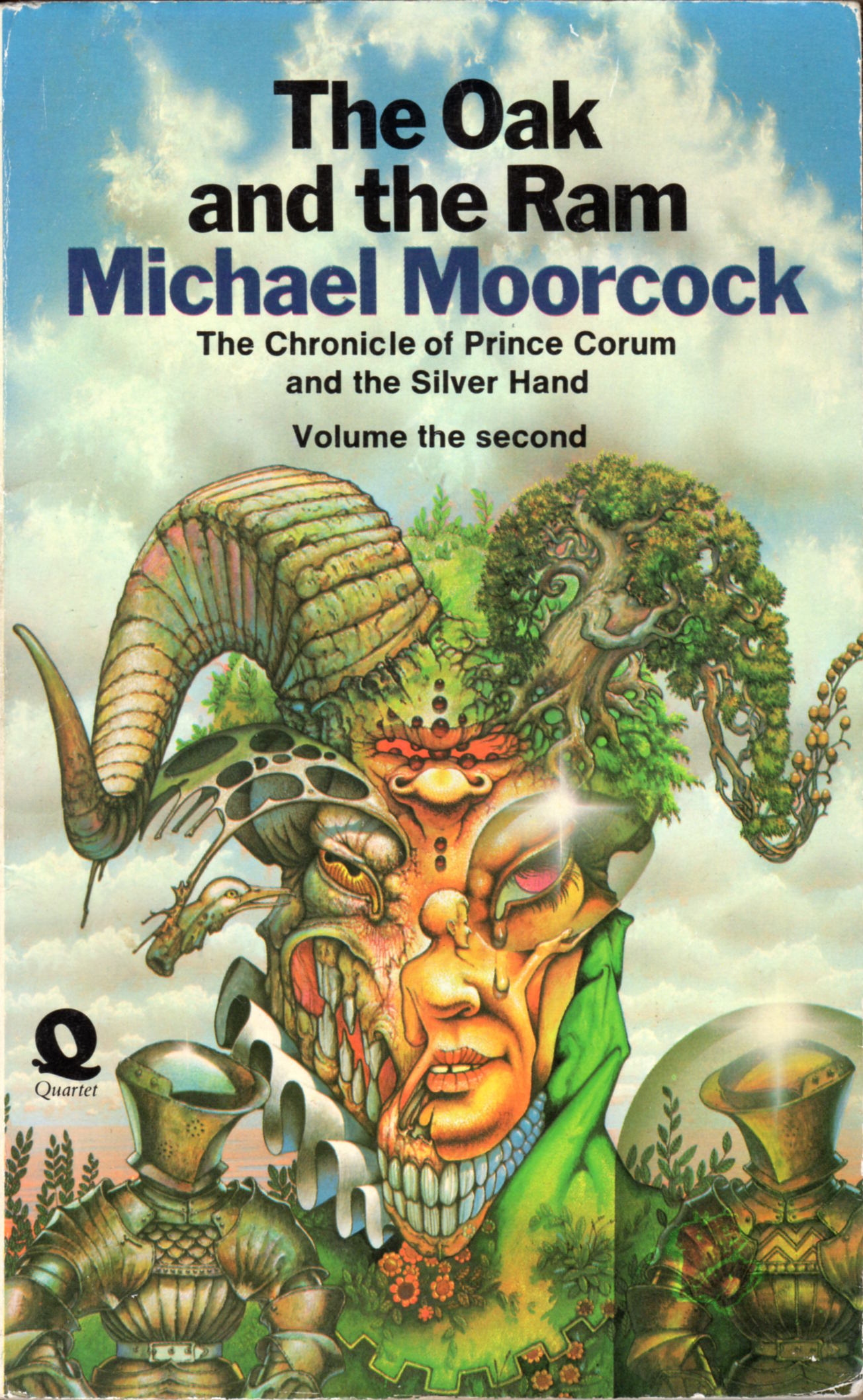
Nice. And you know what? My desire to see more Woodroffe art has been assuaged. I’ll dig that book out some other time, maybe…
I don’t usually buy paperbacks that are in as rough a condition as this copy of Tomboy by Hal Ellson, but I was drawn in by the excellent cover art, which I was surprised to note is by the American illustrator/painter James Bama, who is perhaps best known for his hyper-masculine paintings of cowboys, mountain men, rodeo heroes, Native Americans, and others, including the bronze-haired, bronze-skinned, musclebound pulp-fiction hero Doc Savage! The severe wear and crisscross of cracks and creases on my copy of Tomboy reduce its value, if it has any at all, to that of a “reading copy,” but weirdly, they also seem to reinforce the theme of social disintegration and personal turmoil in the inner city that is central to both the painting and the book:
[CLICK IMAGES TO ENLARGE]

An interesting “bonus feature” of the 1969 Bantam edition of Tomboy displayed above is that it includes an introduction by Fredric “Seduction of the Innocent” Wertham, M.D., who praises the novel “as a good test for people’s knowledge of literature and life.”
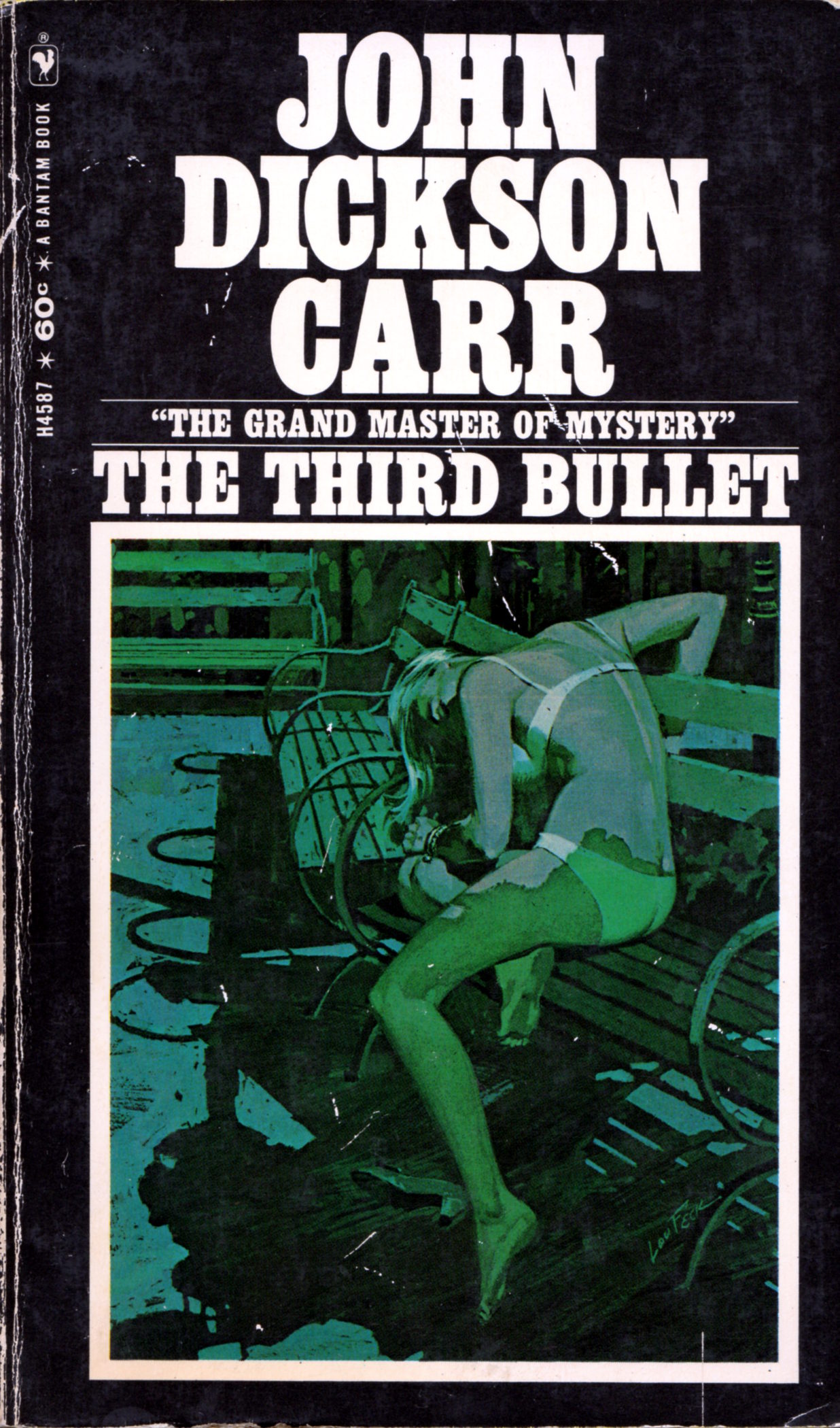
On the one hand, the cropped Feck painting on the front of John Dickson Carr’s The Third Bullet violates two rules of pulp-fiction eroticism: 1) the woman is wearing no shoes instead of having one shoe on and one shoe off (one shoe on the ground doesn’t count), and 2) the shadow on her skin and on the ground is not in the shape of a man’s silhouette. On the other hand, who gives a rat’s ass?
[CLICK IMAGE TO ENLARGE]
Here’s another old paperback that I picked up on our recent trip to Calgary; excellent work here from John Berkey, who is perhaps best known for his lively renderings of impossibly massive spacecraft “screaming” past cities, moons, planets, stars, galaxies, although in his long, productive, successful career in illustration, he actually tackled a wide range of subjects, historical and contemporary, as well as futuristic:
[CLICK IMAGE TO ENLARGE]
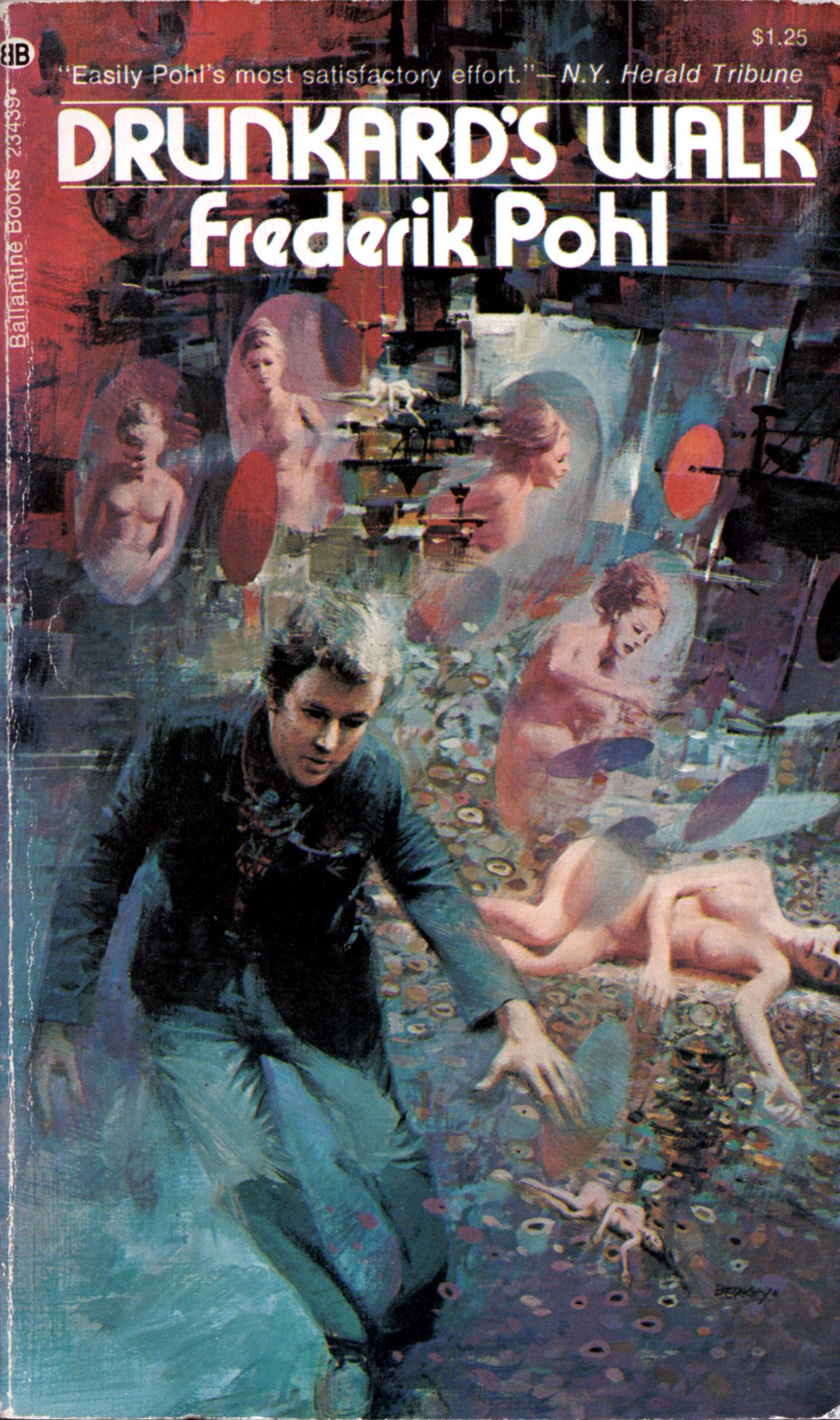
ABOVE: Frederik Pohl, Drunkard’s Walk (NY: Ballantine, 1973), with cover art by John Berkey.
Fourth thing I noticed about Dunkard’s Walk, right after the author’s name, the title, and Berkey’s artwork, was the quotation at the top of the cover: “‘Easily Pohl’s most satisfactory effort.’ — N.Y. Herald Tribune.” Ouch! Was that really the best notice that Drunkard’s Walk had received between its original publication in 1960 and the 1973 reprint you see above? And did that lukewarm “cover quote” ever entice anyone to buy the book?
This is the first cover with art by Doc Savage cover artist Fred Pfeiffer that I’ve scanned and posted here at RCN, and if I can find more with Pfeiffer cover art of a similar quality at a reasonable price, I’ll happily buy and scan and post those, too:
[CLICK IMAGE TO ENLARGE]
 Ragged Claws Network