"This day's experience, set in order, none of it left ragged or lying about, all of it gathered in like treasure and finished with, set aside." –Alice Munro, "What is Remembered"
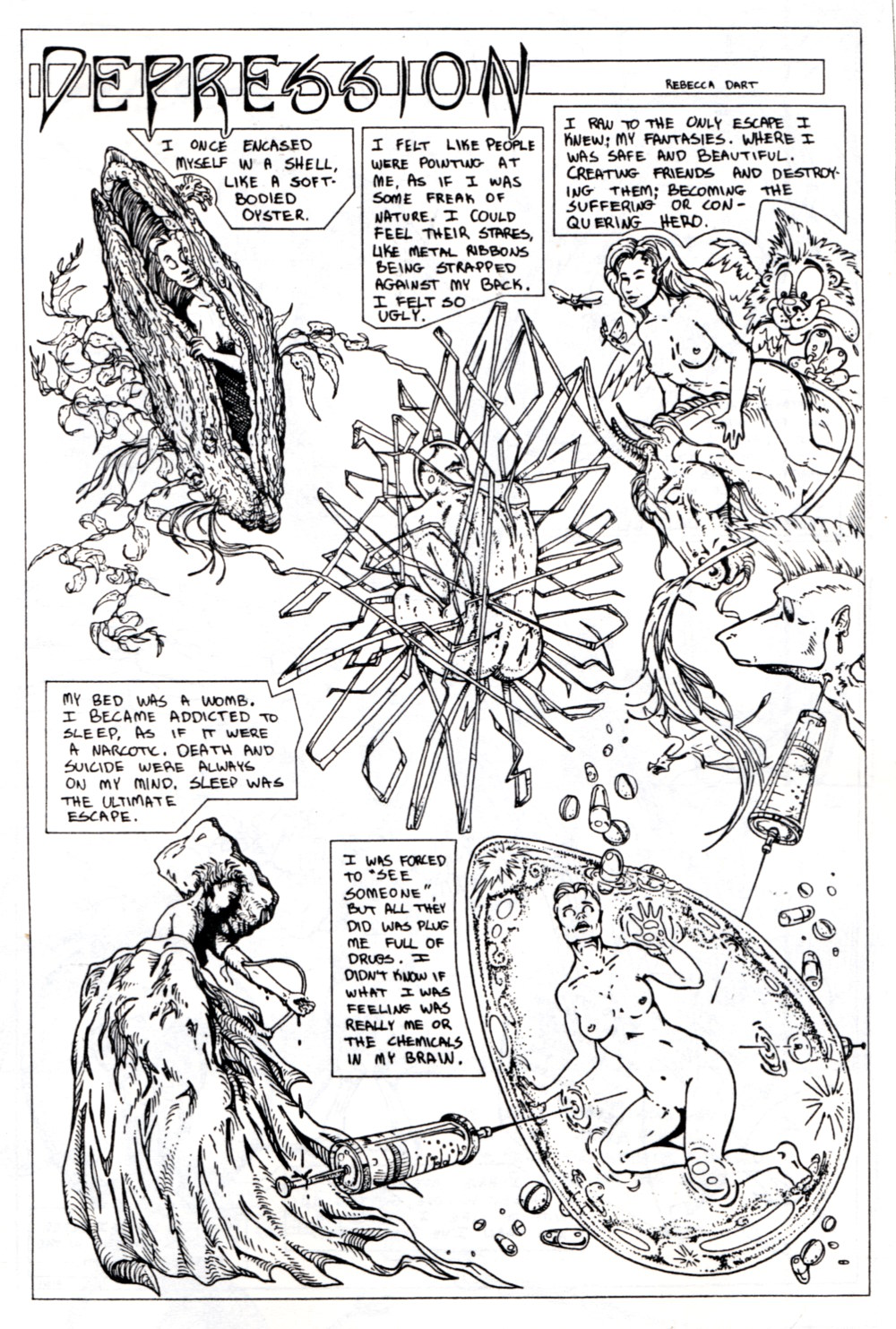
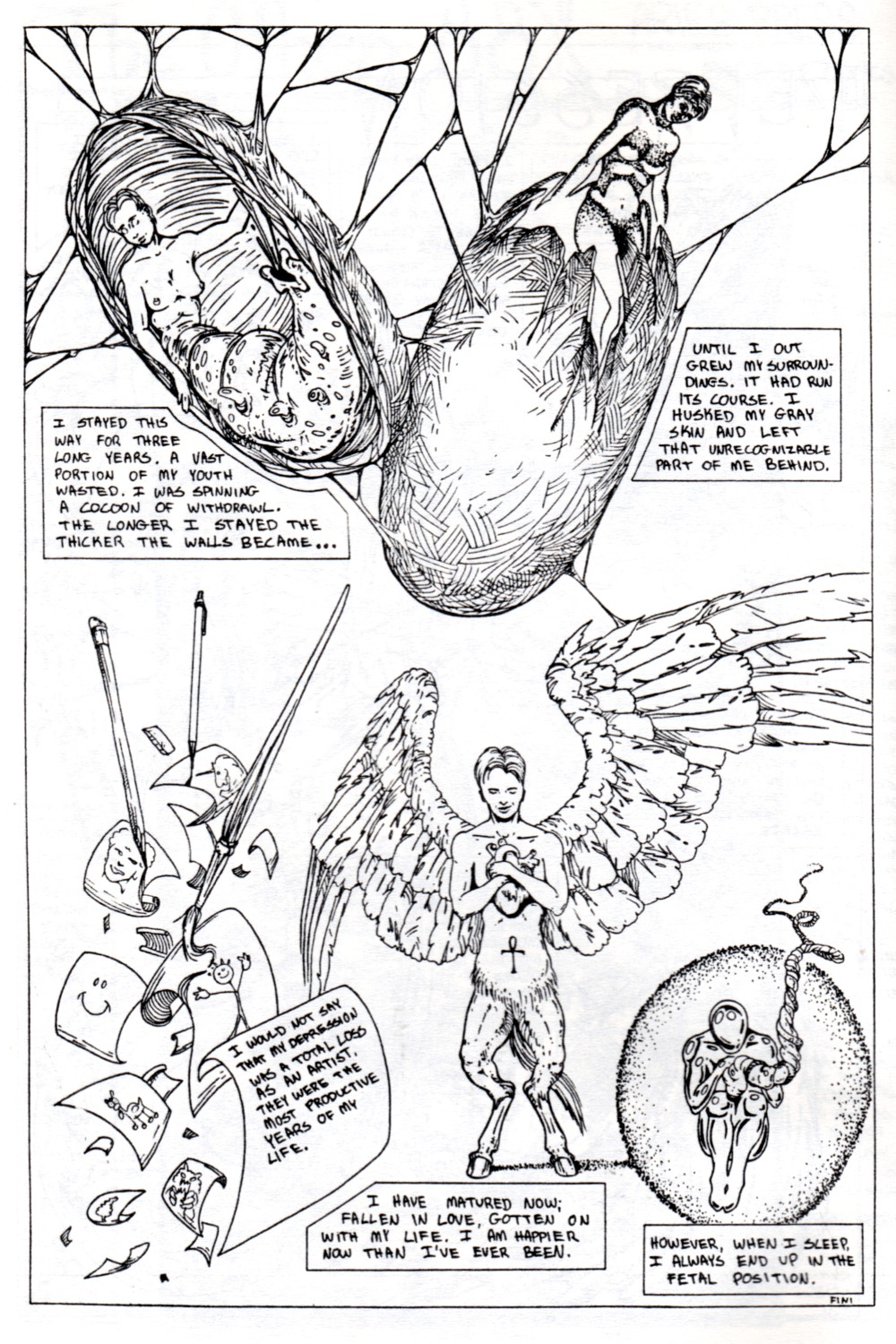
From the mini-comic The Other 88% #1, published way back in November 1993, here’s “Depression,” a heartfelt two-page story by Rebecca “Battle Kittens” Dart, who had just turned twenty in April of that year:
[CLICK IMAGES TO ENLARGE]
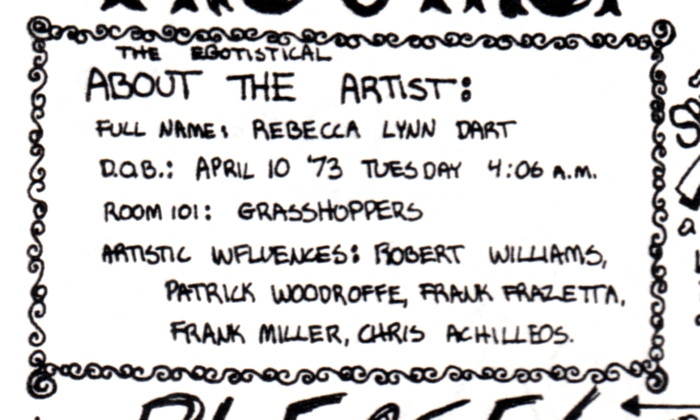
BONUS SCANS: COVER and ABOUT THE ARTIST
REBECCA DART ON THE WEB:
Battle Kittens: The Art of R. Dart – “a handsome 56 page comic-sized collection offset printed on high quality paper. There are 8 pages in full glorious color! This is the best from Rebecca’s sketchbooks and artblog from the last 3 years. This is the good stuff!”
If you want to learn to draw human figures from your imagination, here’s what I recommend…
Stay as far away from Burne Hogarth’s books as possible. Hogarth has absolutely NO IDEA how the human body really moves, and the simplified forms that he draws are only tenuously connected to real human anatomy. Everything of value that is in Hogarth’s books is in Loomis’s Figure Drawing for All It’s Worth, which is available for free as a PDF download from various sites and in a gorgeous facsimile edition from Titan Books. Loomis’s human beings are idealized, yes, but Hogarth’s are monstrosities. Stick with Loomis.
In opening section of Figure Drawing for All It’s Worth, “An Approach to Figure Drawing,” Loomis emphasizes the importance of the “mannikin figure” or “mannikin frame,” by which he means not merely the wooden figures that one can buy at an art supply store, which have somewhat limited usefulness, but lively three-dimensional, repeatable graphic visual simplifications of both male and female human bodies that one has practiced drawing from many angles and in a variety of poses until the process of construction has become second nature. “I am of the opinion,” writes Loomis, ” that to teach anatomy before proportion — before bulk and mass and action — is to put the cart before the horse.” Loomis offers his own version of a skeletal mannikin figure, and demonstrates how to manipulate and flesh it out in a generalized way, but the point here is not that you must slavishly copy Loomis. Rather, the point is simply that if you are to reach your goal of drawing human figures from your imagination, you must endeavour to develop a conceptual mannikin figure of your own that you can use to lay out your compositions and that can serve as a solid basis for the more “realistic” figures that you will produce once you have increased, via intensive study and practice, your mental store of information about appearances, anatomy, movement, and so on (see below).
Always try to keep in mind (until it becomes second nature) Loomis’s BIG IDEA, which is that perspective applies to human bodies as much as it applies to buildings.
George Bridgman’s books are held in high esteem by experienced artists, but Bridgman’s drawings can be very difficult to decipher if you don’t already know what you’re looking at, so the books are not very good for beginners. IMHO, of course.
Buy the Vilppu Drawing Manual and follow Glenn Vilppu’s course of instruction. Vilppu sells the book via his website. His videos are also helpful because they enable you to watch him put theory into practice. A couple of Vilppu’s students have figure-drawing books out right now that are basically just the Vilppu method condensed and repackaged in a glossy format. Don’t buy those books. Buy Vilppu’s coil-bound original.
Buy a good anatomy book written for artists and USE IT. My top two recommendations from among the big “artistic anatomy” books that are currently in print and easily obtainable are Classic Human Anatomy: The Artist’s Guide to Form, Function, and Movement by Valerie L. Winslow and Atlas of Human Anatomy for the Artist by Stephen Rogers Peck. I also really like Anatomy: A Complete Guide for Artists by Joseph Sheppard, whose old-master influenced drawings are not only admirably clear but also aesthetically pleasing and inspiring in a way that drawings in modern anatomy books seldom are. And last but definitely not least, I like The Human Figure: An Anatomy for Artists by David K. Rubins, which is short, inexpensive, and has some of the clearest drawings of musculature of any artistic anatomy book I’ve seen. In fact, I like Rubins’s book so much that I cut the spine off of my copy and replaced it with a cerlox or “comb” binding, using a heavy-duty machine that I purchased for cheap at the local Habitat for Humanity Re-Store, so that I could lay book flat on my work surface for easy reference. But YMMV, as the kids used to say.
Sign up for a weekly class that offers the opportunity to draw from live nude models without instruction. Attend the class, and during the longer poses, attempt to draw exactly what you see. As you work your way through the Vilppu Drawing Manual, you will naturally begin to analyze the model in terms of simple volumes and anatomical landmarks; you will also learn about the importance of gesture. Vilppu doesn’t place much stock in contour drawing, but practice contour drawing anyway and work to incorporate specific details of what you have observed into the drawings that you make when you are not sitting in front of the model.
Don’t hesitate to use photo-reference that you’ve paid for or shot yourself to supplement your memory/imagination. Photographs can be misleading, sure, but treated as a source of telling details rather than as the last word on appearances, they can also help you breathe life into your constructions.
Keep a mirror close by, the larger the better, and use it, and your own body, to identify and solve problems in your figure drawings.
You’re allowed to erase. And you’ll be able to erase more easily if you keep a light touch in the early stages of your drawing. Sometimes, when you’ve made a serious blunder, like placing an arm in a position that is physically impossible for a real human being, you will want to erase completely and get back to white paper; at other times, however, you will want to leave the ghost of a good but not great form as a guideline for a smoother, more precise attack. Yes, you could place your incorrect drawing on a light box with a new sheet of paper over it and redraw it, or you could work on successive overlays of tracing paper. But keep in mind: erasing all but a ghost of the image is just as effective as those other methods, and it’s cheaper, too.
If you have the money and the time, sign up for a class in figure drawing with a good instructor. (Here’s a rule of thumb: if you can help it, don’t sign up for a class with an instructor who refuses to draw in front of the class.) Also, diligently attempt to do ALL of the assignments that the instructor asks you to do and work to incorporate his or her advice into your drawings. If you don’t want to do any assignments and you don’t want any advice, don’t sign up for a class in figure drawing that includes any instruction, period. You’ll only be wasting your money, your time, your instructor’s time, and, worst of all, your classmates’ time and money.
Jack Hamm’s Drawing the Head and Figure is an inexpensive book that is packed with interesting and useful tidbits of information. Definitely not essential, but I daresay that no other book on figure drawing delivers as much value for money.
Draw, draw, draw, draw, draw, draw, draw.
… or go your own way, and let your freak flag fly, because drawing naturalistic human figures in a convincing manner from your imagination is by no means the be-all and end-all of art.
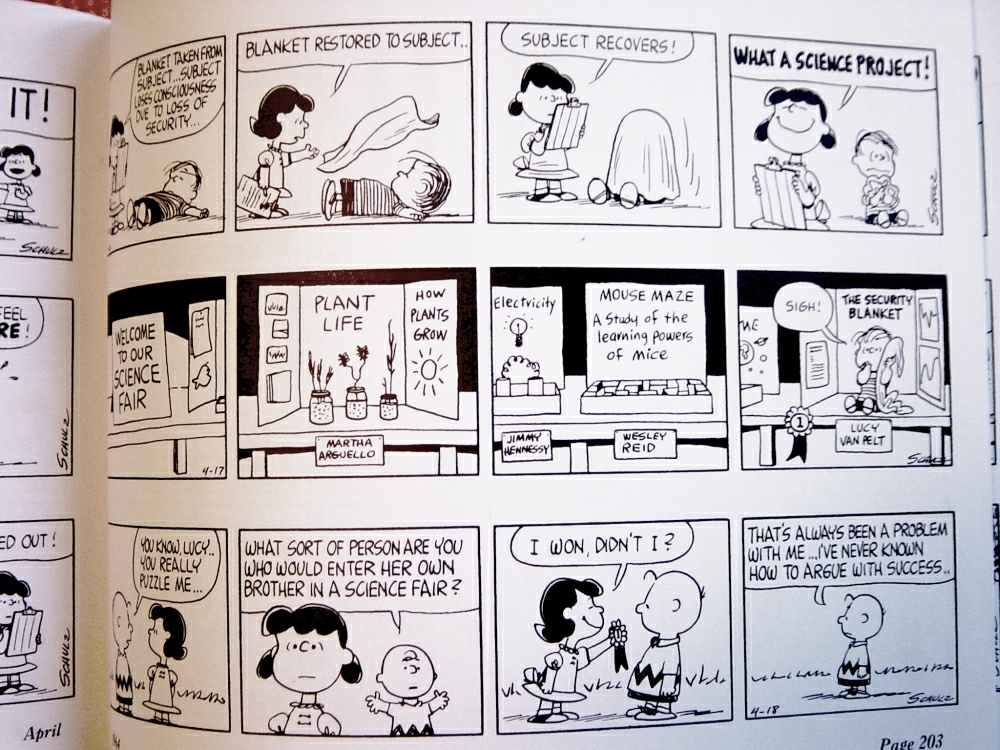
Fans of the comic strip Peanuts will undoubtedly remember the startling sequence of strips from 1964 in which Lucy enters Linus and his blanket as her project in the school science fair:
[CLICK IMAGE TO ENLARGE]
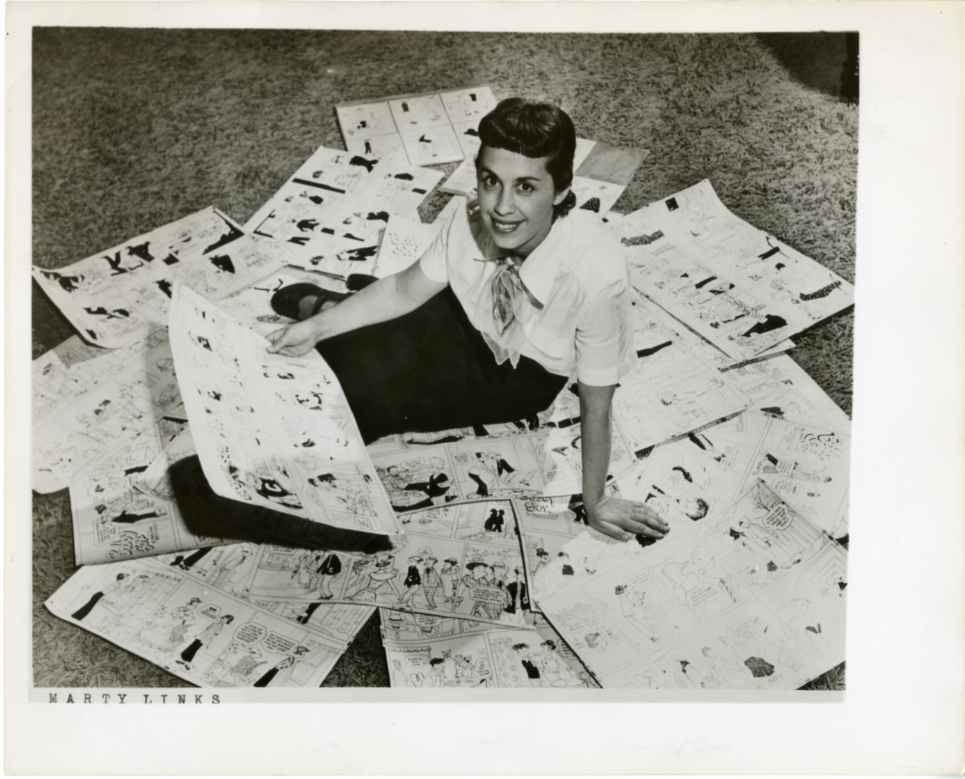
And if you are a superfan of Peanuts, you probably know that Schulz used the name “Martha Arguello” for one of the contestants in the science fair (see strip 4-17-64, The Complete Peanuts 1963-1964 [Vol. 7, Fantagraphics Books], p. 203) as a tribute to his fellow cartoonist and friend, Marty Links, the creator of the comic strip Bobby Sox, which was later renamed, and is perhaps better known as, Emmy Lou:
Marty was short for Martha, obviously, and Arguello was the storied surname of Martha’s high-school sweetheart, Alexander Arguello, whom Martha Links married in 1941.
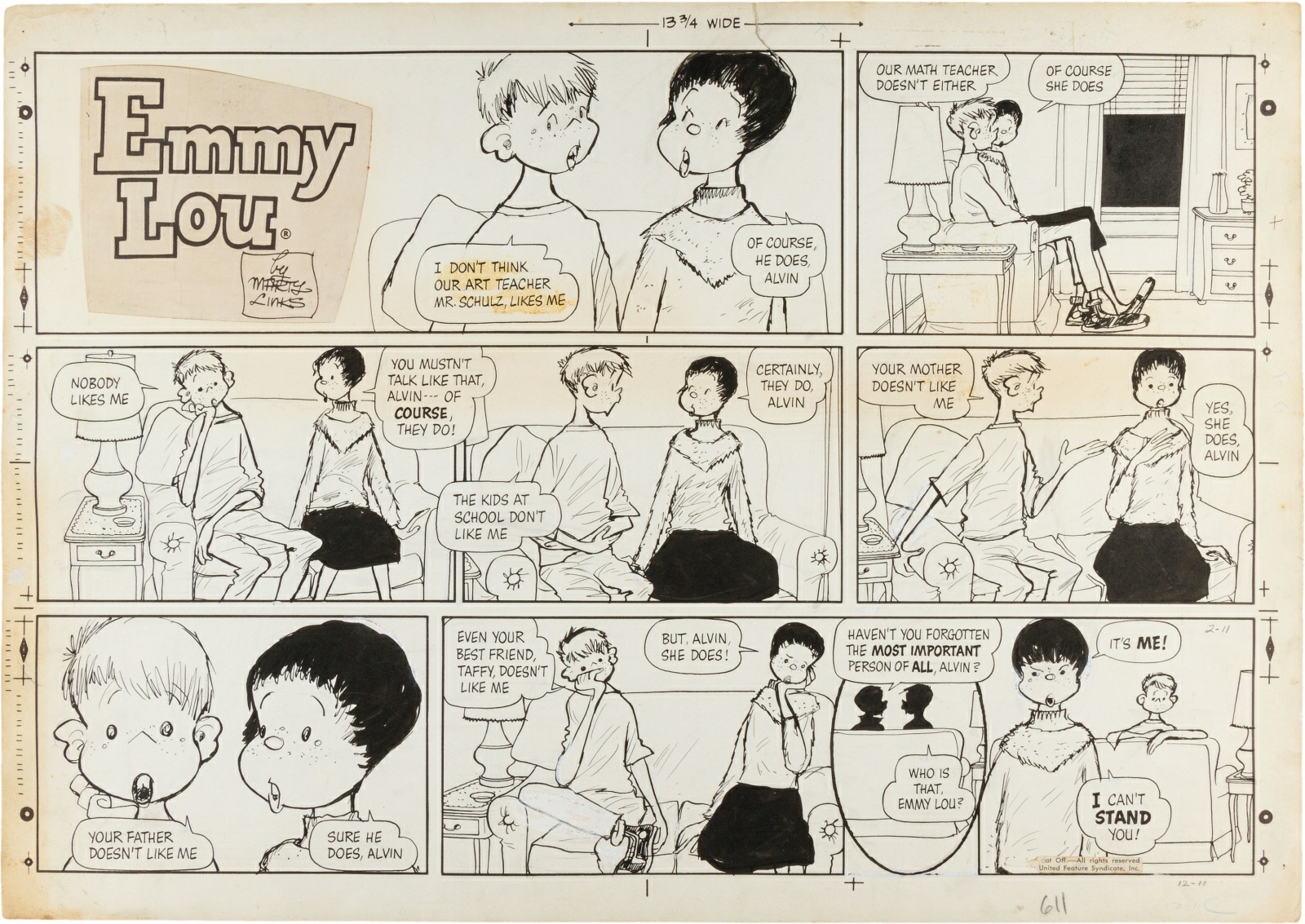
What even superfans of Charles Schulz may not know, however, is that Marty Links actually included a nod to Schulz in Emmy Lou! How do I know this? Because I recently purchased the Emmy Lou strip in which it happened from Heritage Auctions. Here’s the strip:
As you can see, in the first panel, Emmy Lou’s sad-sack boyfriend, Alvin, says, “I don’t think our art teacher Mr. Schulz, likes me.” Now, I doubt that any cartoonist would use the name Schulz in a comic strip by accident; it’s almost certainly a name check. But were Schulz and Links also friends? And were they close enough that Schulz might have dared to diss Alvin, or that Links might have dared to kid Schulz in her strip? From a TV interview with Marty Links posted below, here is a short excerpt in which Links mentions her friendship with Schulz and expresses her admiration for his work:
JAMES DAY: Do cartoonists get together at all?
MARTY LINKS: Well, yes, I know Sparky Schulz very well; he’s a very good friend of mine.[…] When I’m with Sparky, and I see his work,[…] I’m so lost in admiration, I guess of his genius, that I just stand there and not even think of cartooning; in reference to myself, I’m just admiring the works.
So who knows? The real Mr. Schulz might actually have told his friend Marty Links that he didn’t like Alvin; he certainly didn’t hesitate to comment to his cartoonist-friend Lynn Johnston about developments in her strip For Better or For Worse.
Not that it matters. Because even if Schulz didn’t say a word to Links about Alvin, Links’s/Alvin’s reference to “our art teacher Mr. Schulz” remains a nod to the genius cartoonist Mr. Schulz, I think.
Of course, the irony is that, after having spent the entire evening reassuring Alvin that everyone, including Mr. Schulz, really does like him, Emmy Lou herself finally loses patience with Alvin’s relentless self-pity:
EMMY LOU: Haven’t you forgotten the most important person of all, Alvin?
ALVIN: Who is that, Emmy Lou?
EMMY LOU: It’s me! I can stand you!”
Unfortunately, the copyright information that was glued to the art that I now own is partially missing, so I don’t know if Marty Links’s tribute to Schulz occurred before or after Schulz’s tribute to Links/Arguello.
BONUS VIDEO:
Here’s a charming interview with Marty Links that was taped on 05/08/75 for the public-television series Day at Night:
BONUS LINKS:
Hairy Green Eyeball 2 > Emmy Lou and Sweetie Pie – includes twenty-five one-panel strips scanned from the collection More Bobby Sox: The Life and Times of Emmy Lou.
Hairy Green Eyeball 2 > Bobby Sox by Marty Links – twenty-six more one-panel strips scanned from the collection More Bobby Sox: The Life and Times of Emmy Lou.
John K. Stuff > Bobby Sox By Marty Links – eleven one-panel strips scanned from the collection More Bobby Sox: The Life and Times of Emmy Lou.
A few months ago, I picked up a couple of “bales” of National Lampoon Magazine — thirty-two issues, in all — from a local bookseller for cheap. It was only when I got home with my bales and cut the strings that I found out that all but one of the issues were from the 1980s and 1990s, which was okay because, at the very least, it gave me quite a few terrific comic strips by M. K. Brown, R. Crumb, Shary Flenniken, Rick Geary, Buddy Hickerson, Mark Marek, Rodrigues, Gahan Wilson, et al., to read. The lone exception, however, was an issue from November 1975, which — o lucky me! — includes the second-last Idyl strip by Jeffrey Jones that ever appeared in the magazine.
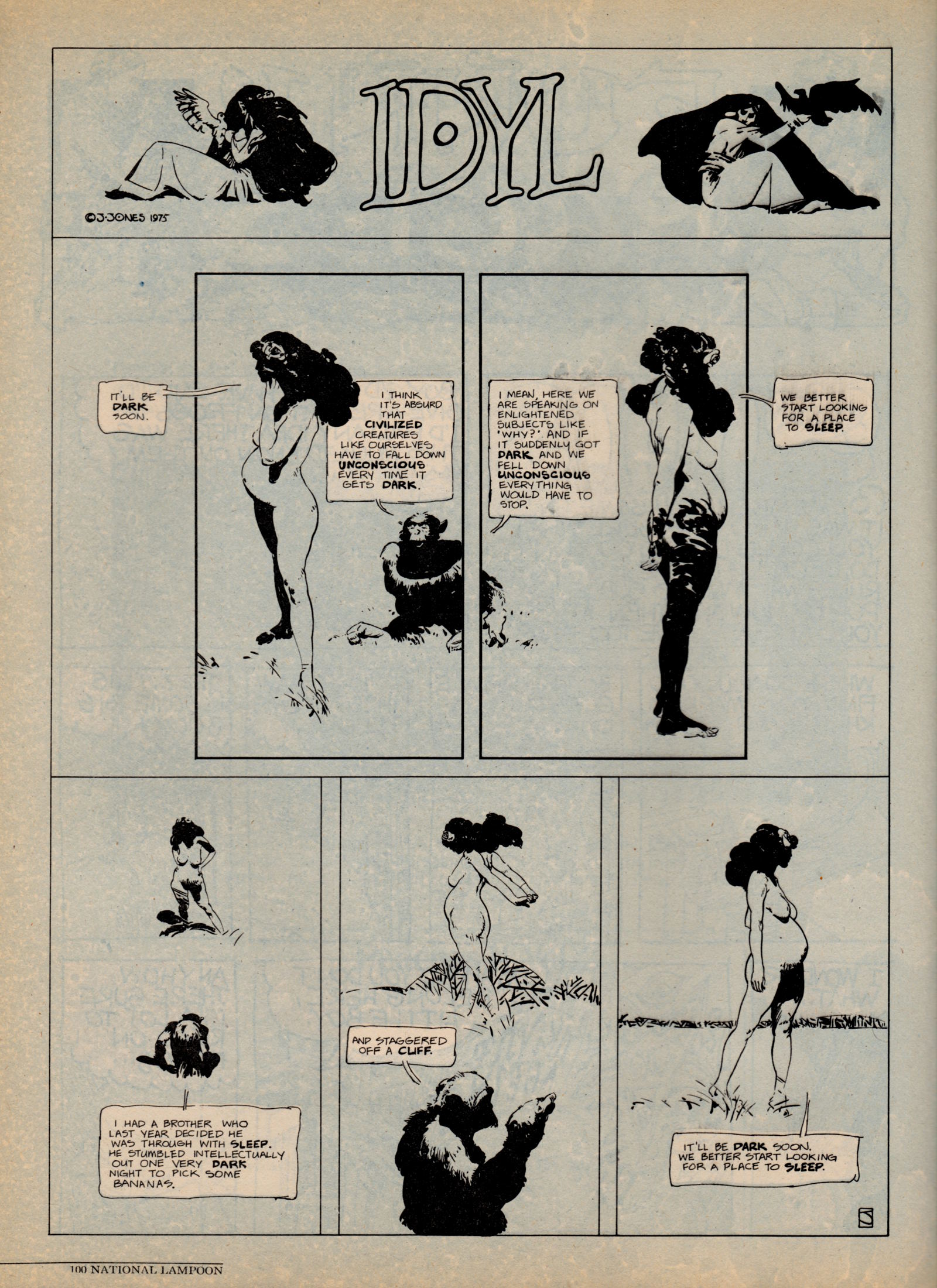
Now, if all you’ve seen are reprints of Idyl, you might be interested to know that the strip first appeared in a newsprint section of the Lampoon called “Funny Pages” and that, in the November 1975 issue, all of the strips in the “Funny Pages,” including Idyl, were overprinted in light blue with only the word balloons left uncoloured. To give you an idea of the sombre, twilight mood that the blue colour lends to Jones’s strip — which begins with the words, “It’ll be dark soon” — I present to you the following scan:
[CLICK IMAGE TO ENLARGE]
The effect is so appropriate to the theme of the strip that one can’t help but wonder if the art director didn’t choose the colour specifically to complement Jones’s work…
“Idyl was intended as satire and whimsy. One art director and one editor, who met me each month with puzzled faces, continued to remind me that National Lampoon was a humor magazine, ‘As long as YOU laugh,’ they finally said. So each month I would go in laughing. I also must admit that I love to draw nude women.” — Jeffrey Jones, interview, 2001
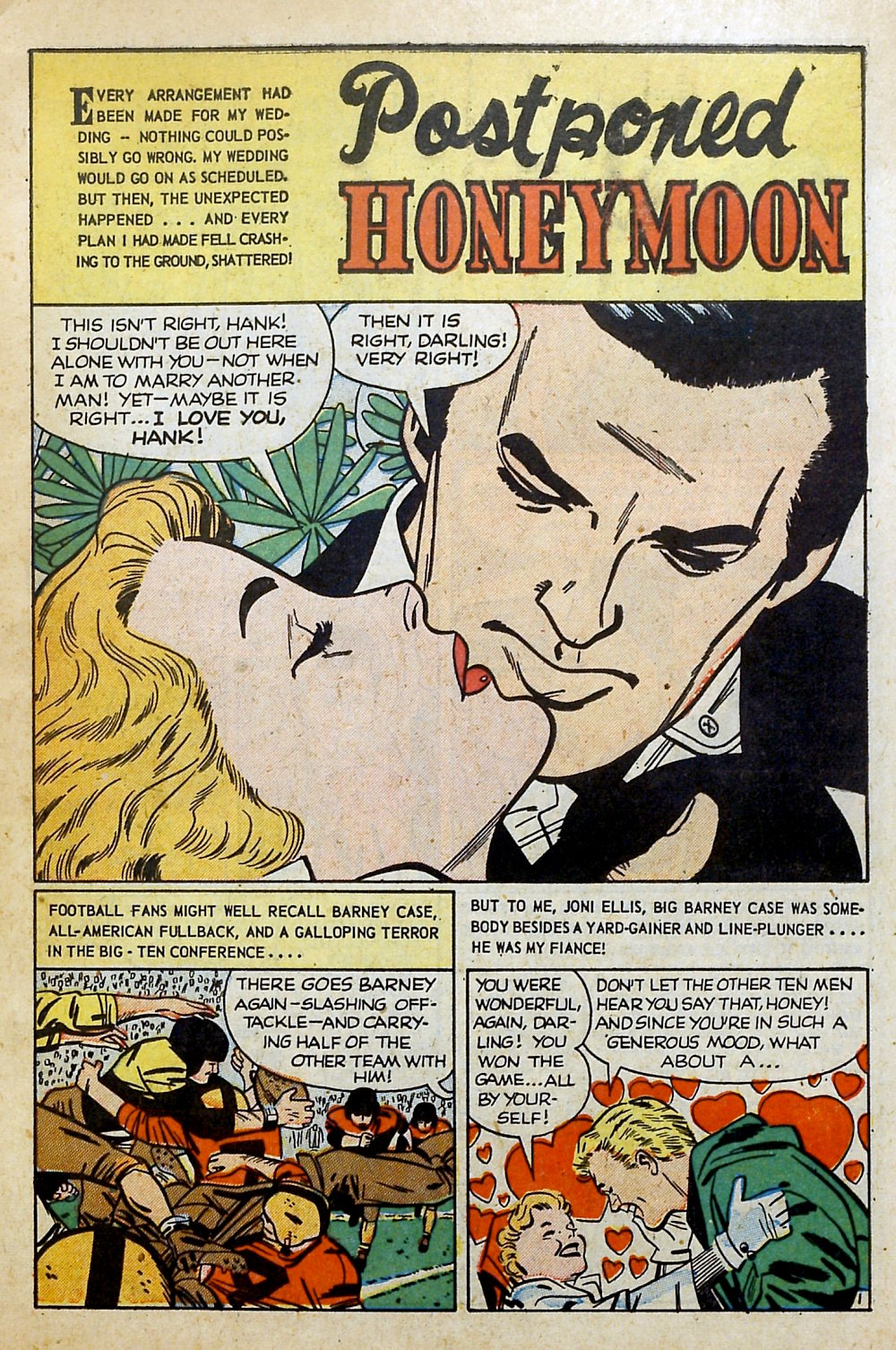
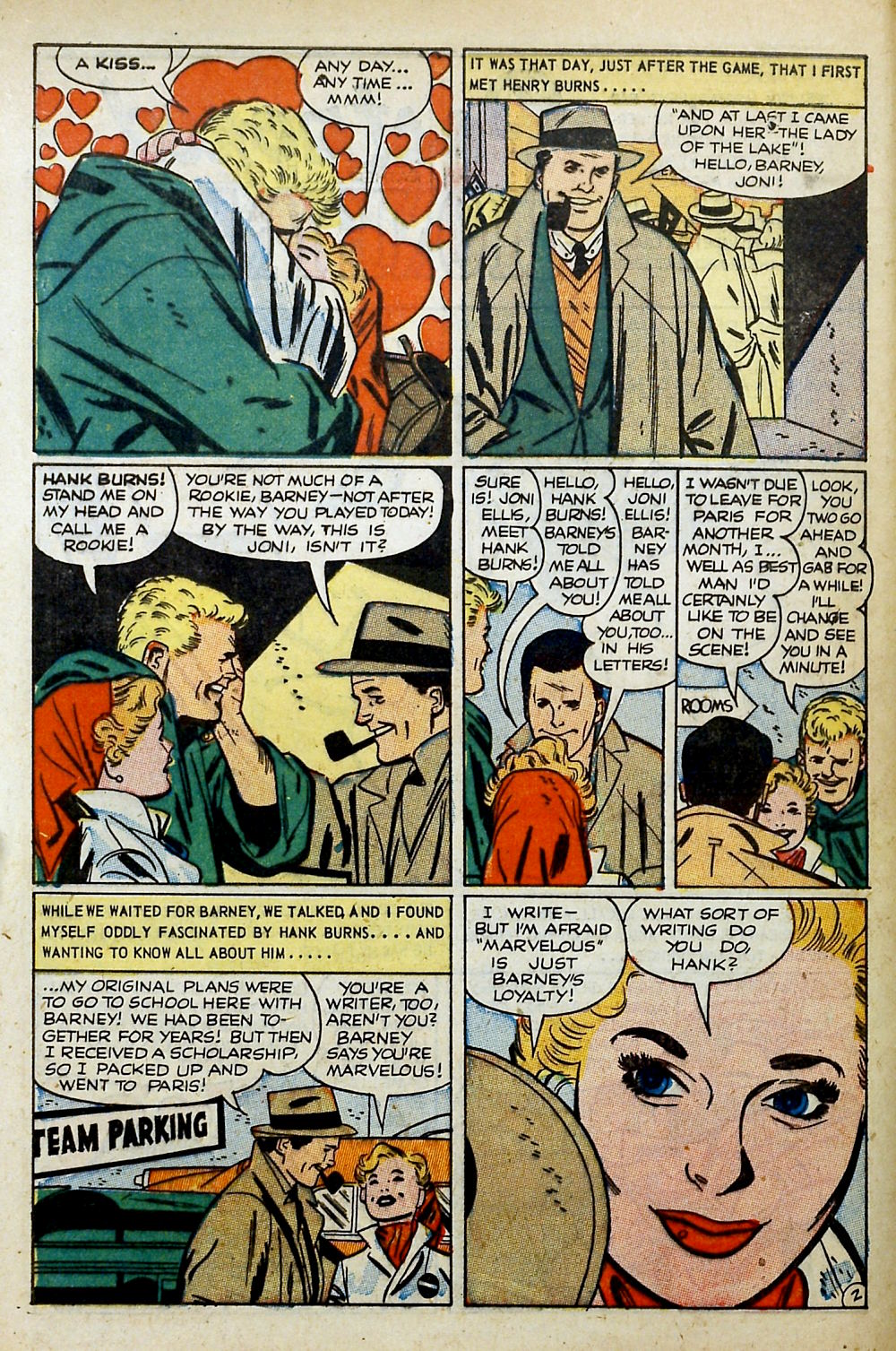
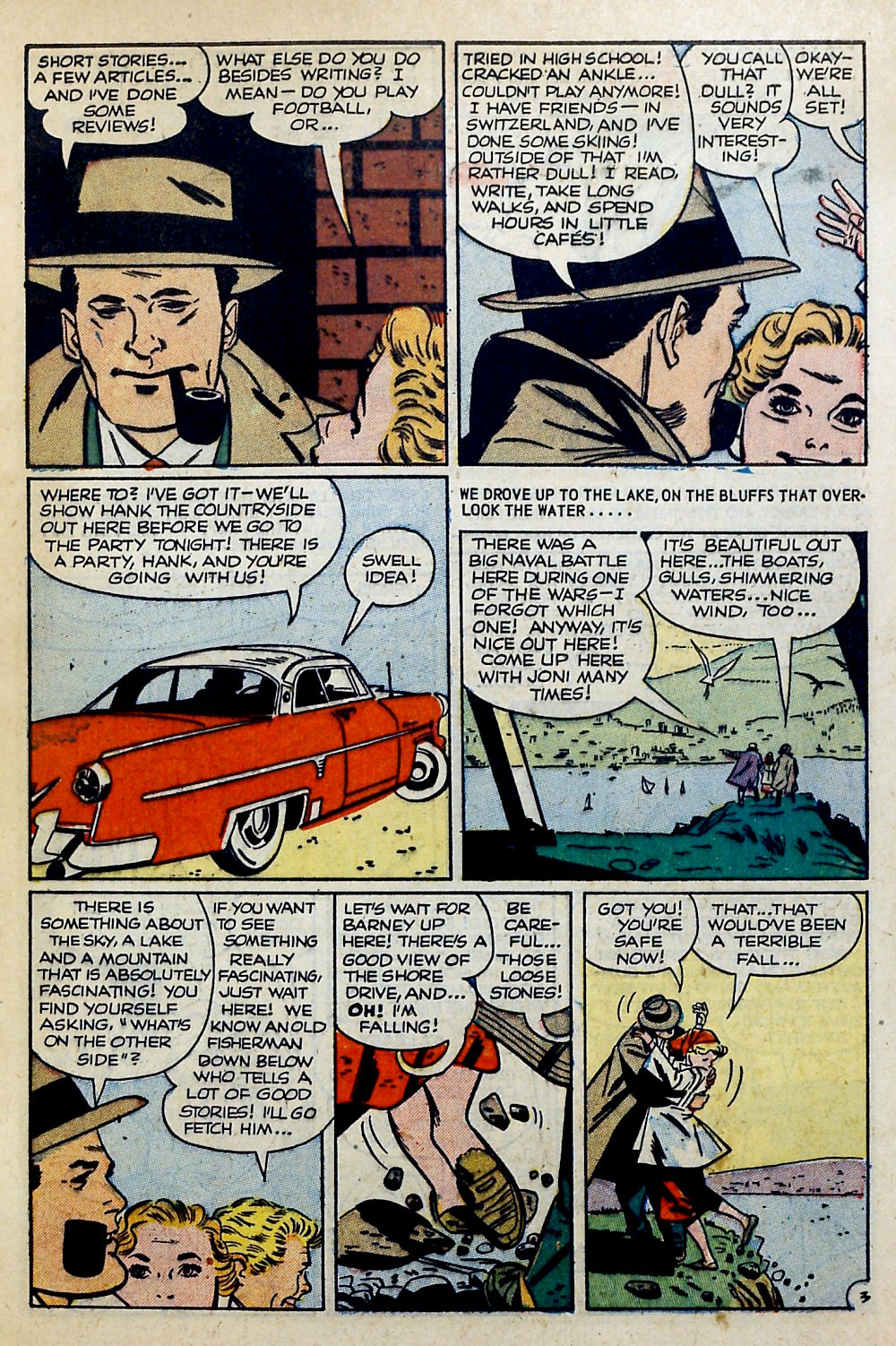
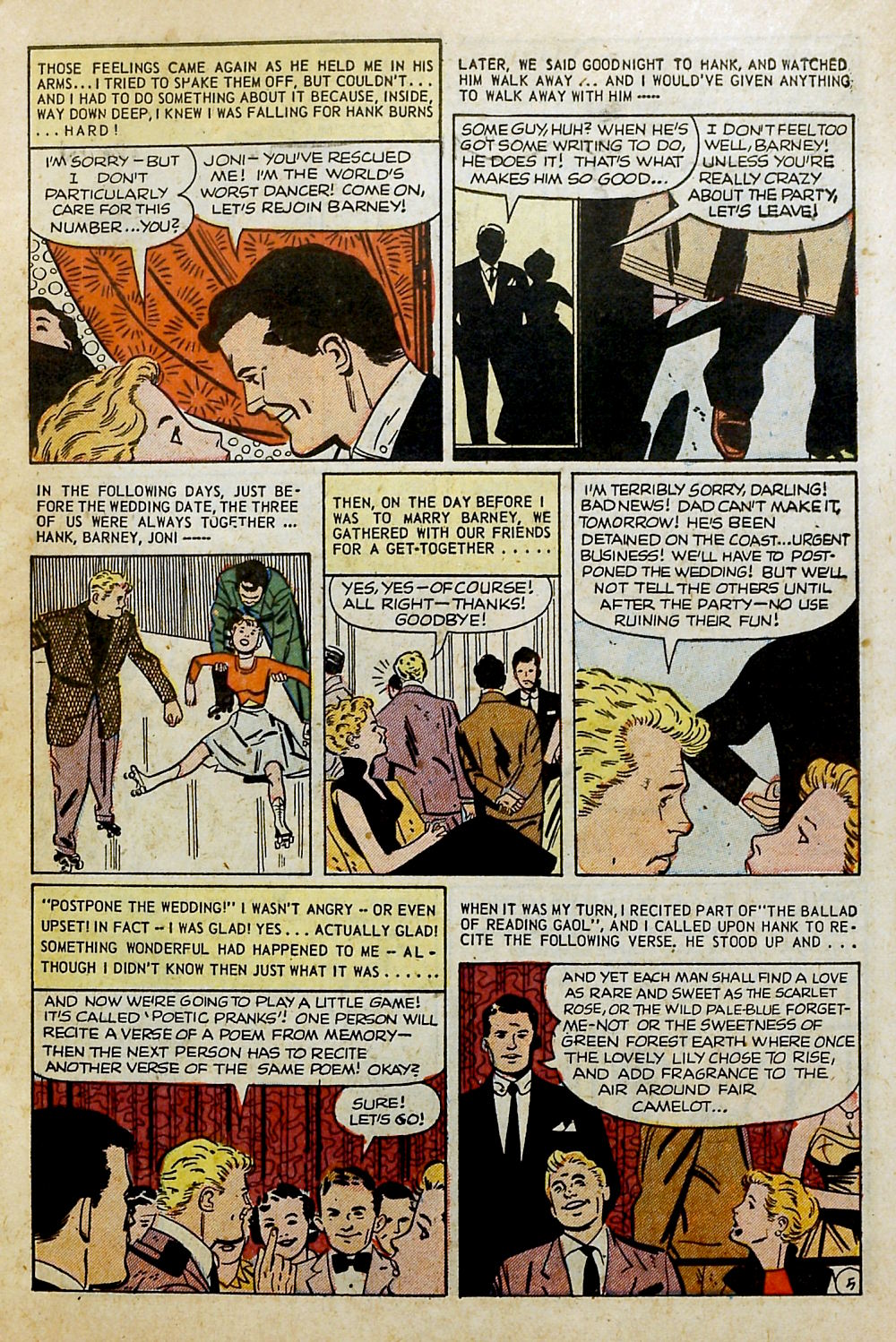
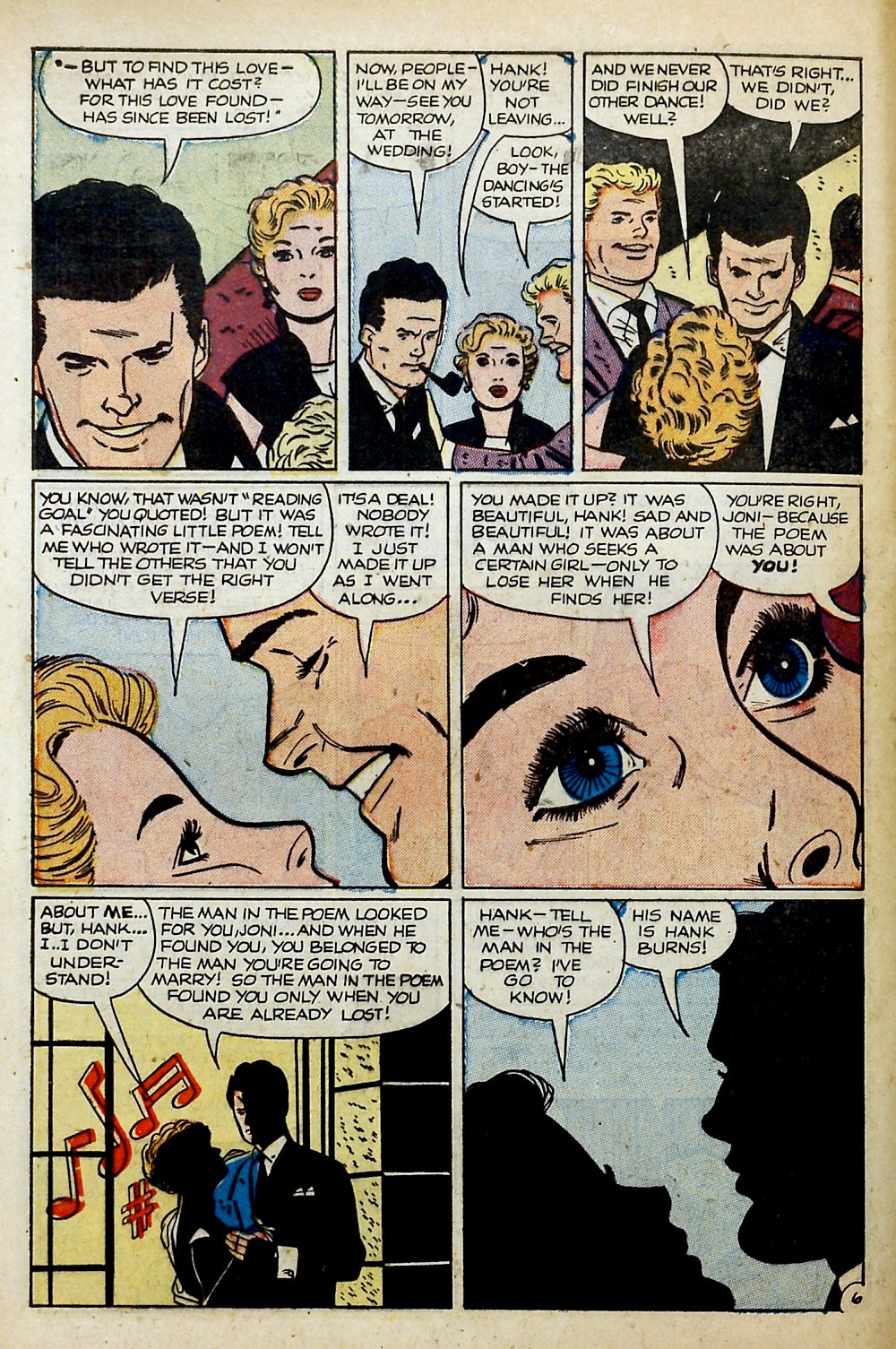
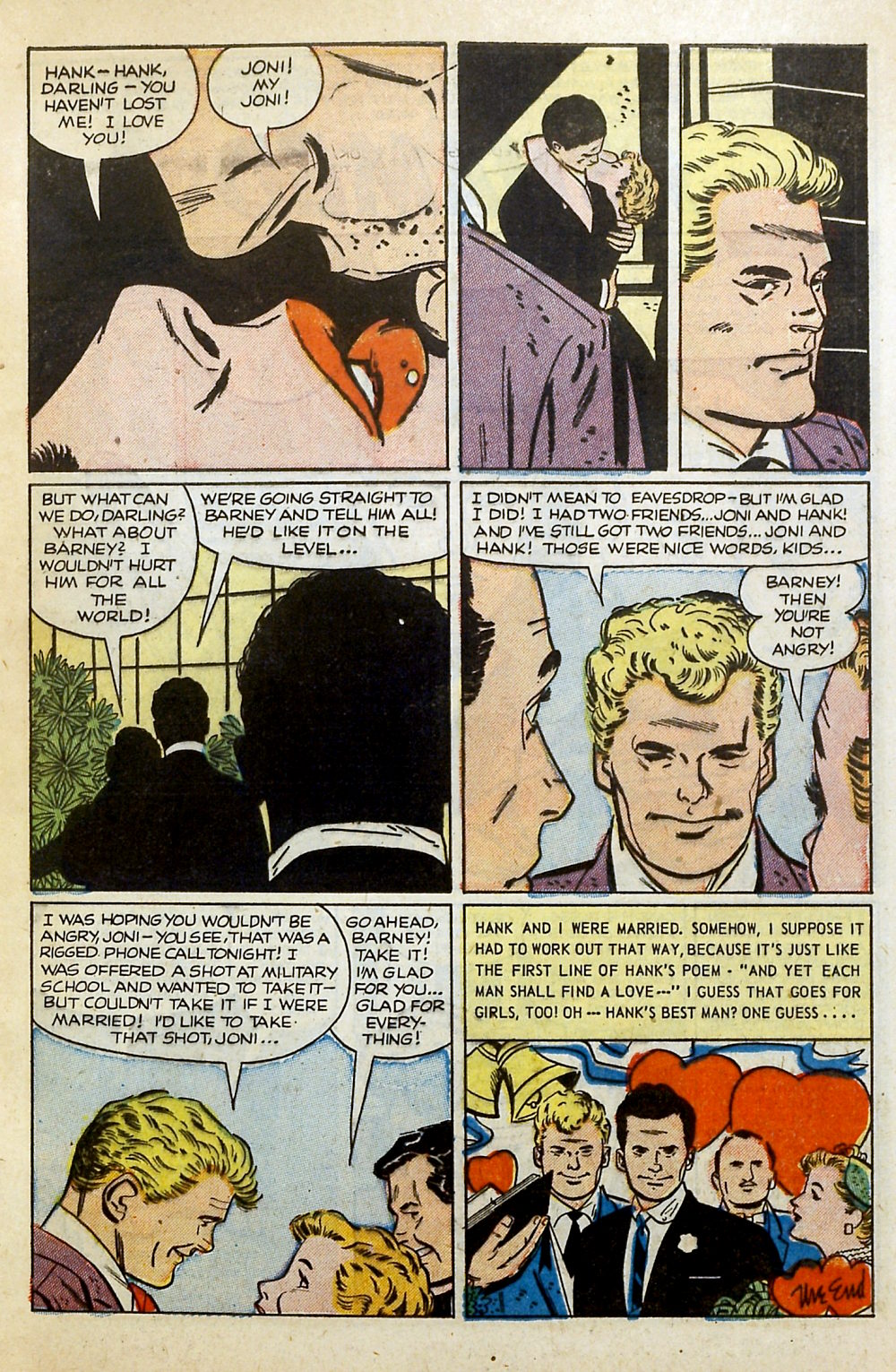
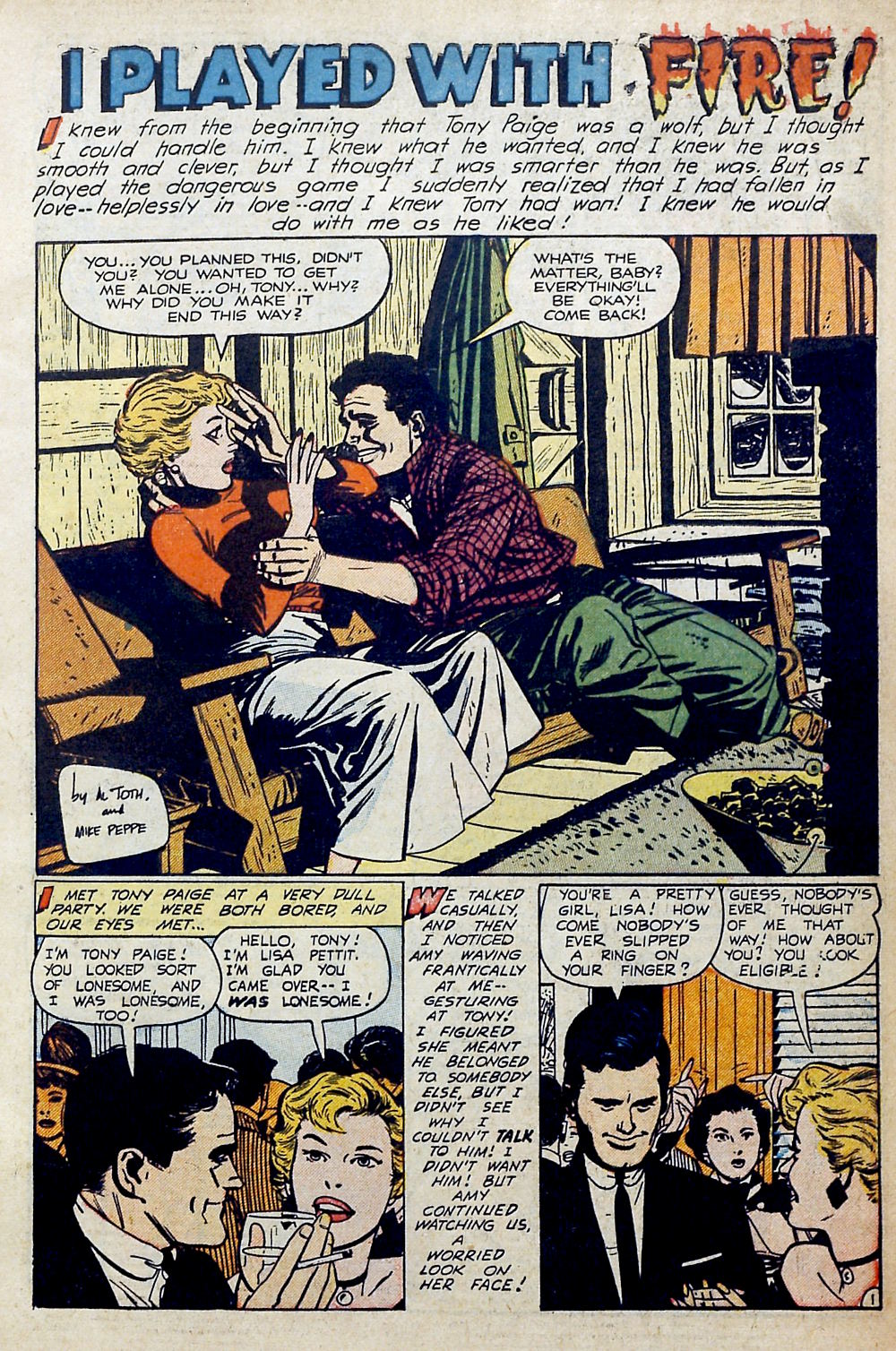
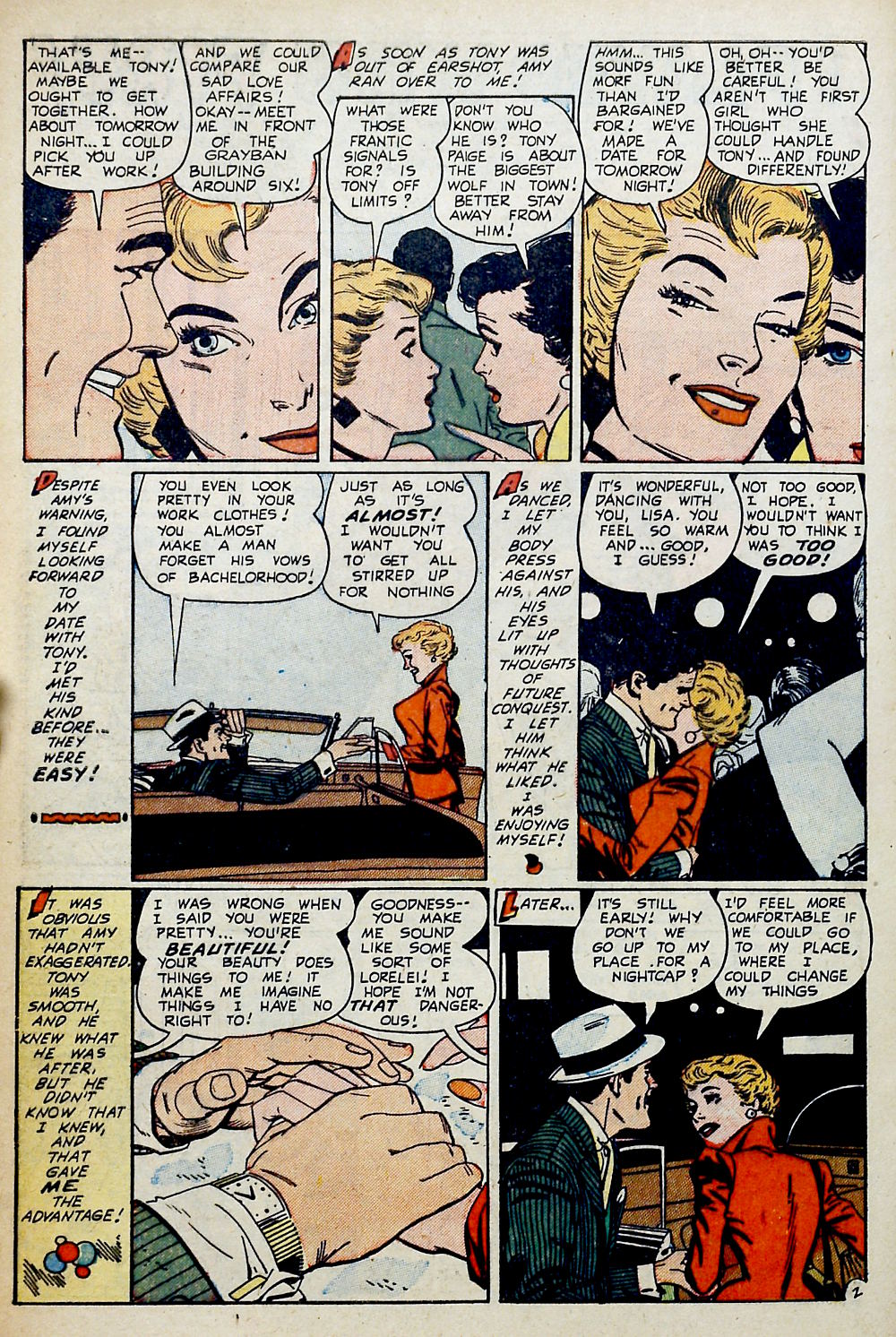
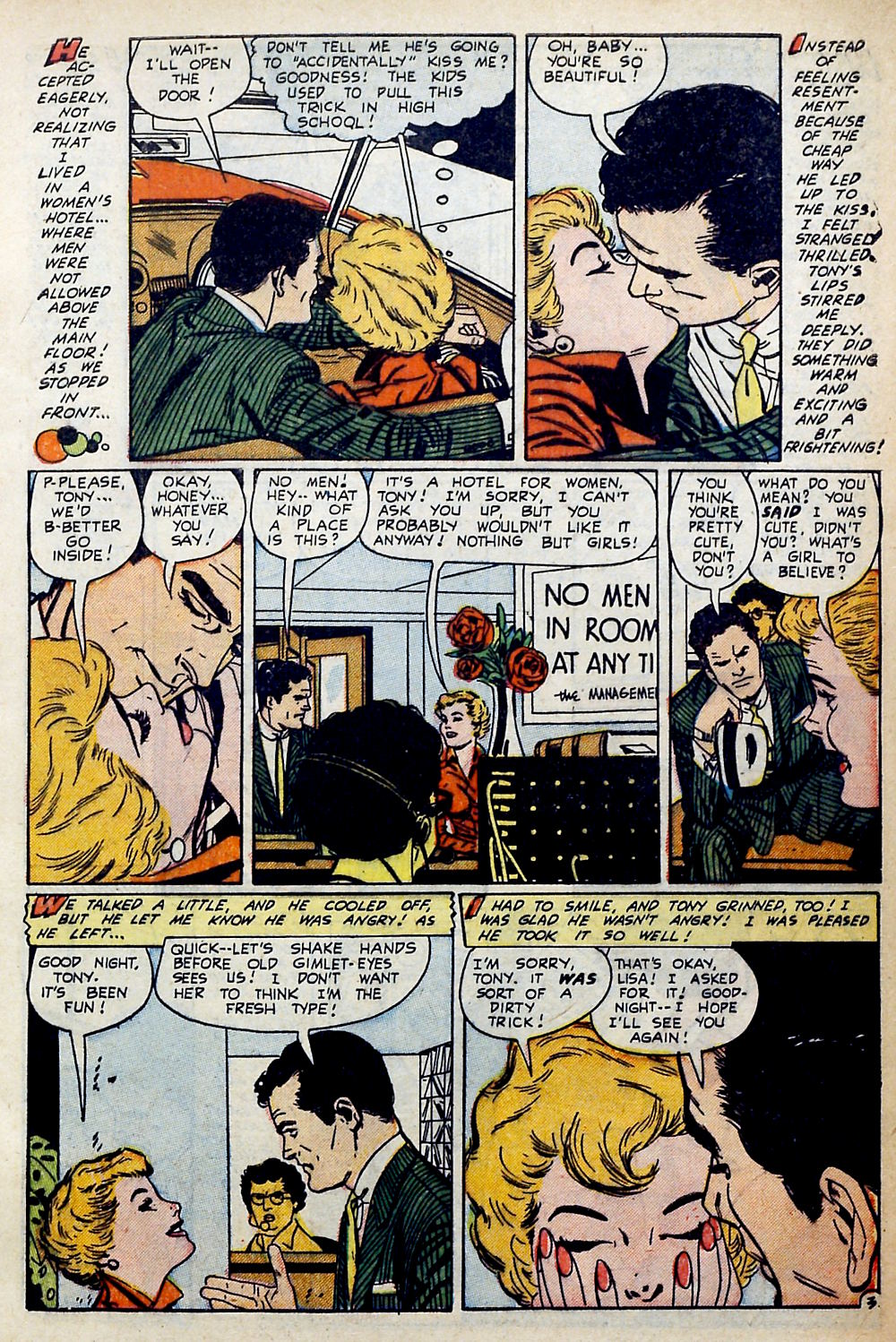
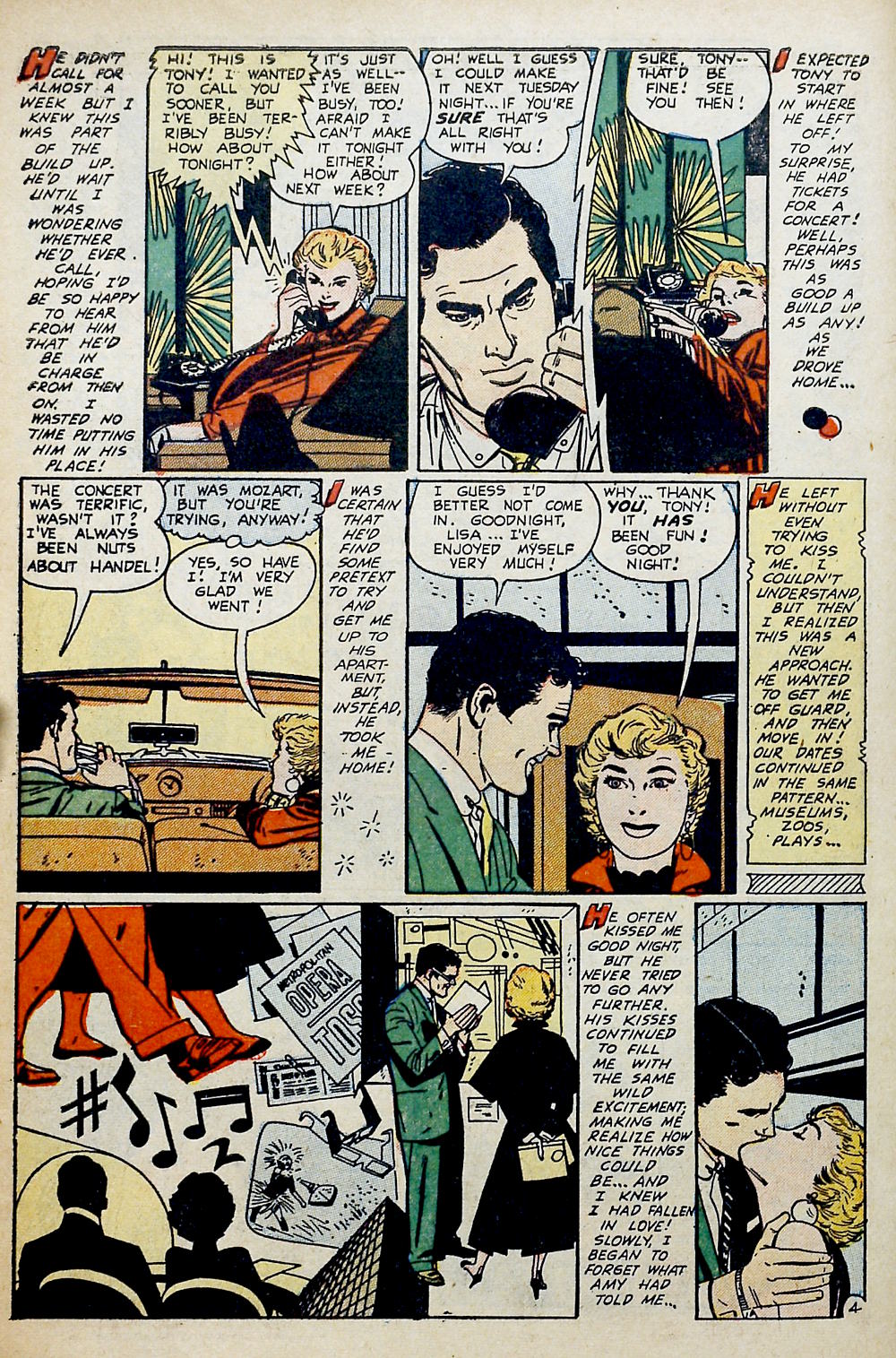
Notice how, in panel after panel, Toth chooses to draw Joni looking at Hank rather than at her fiance Barney. The last panel of page two, the fifth panel on page three, and the fifth panel on page six are especially revealing in this regard; it’s the direction and intensity of Joni’s gaze that reveals her heart’s desire.
At the end of January, I posted a “Heads Up” to alert collectors of comic art to the grand opening of the well-stocked Etsy shop of Atlanta-based artist Jess (née Jeff) Jonsin (née Johnson). At that time, I had already purchased page six of a story, “Gruesome Charlie in ‘No Erect Penises,'” that originally appeared in Zero Zero #4 (Fantagraphics, August 1995). In the days that followed, however, I found myself returning several times to Jess’s Etsy shop to examine the other five pages in the story. Each time, I half-expected that one or the other of the pages would be sold, but also sort of hoped they would all still be available for purchase, until finally I talked myself into making an offer on the lot of them. Jess graciously accepted my offer, so now I’m back to share, with Jess’s permission, the complete story scanned from the original art:
[CLICK IMAGES TO ENLARGE]
Regarding the title of the story, Jess volunteered the following explanation during a conversation we’ve been having on Etsy:
And I wanted to tell you some things: The story you’ve bought was originally conceived for Blab! Monte [Beauchamp] didn’t think it suited, and I’m sure he was right; I reconfigured it later for Zero Zero. Kim [Thompson] only stipulated that there be “No Erect Penises” which kept me from calling it something appropriate like “Dancing Frogs.” The “Gruesome Charlie” character, or at least the name, has a hypnagogic origin, as does “Voluptuous Dog.” That’s all that comes to mind about that story right now. I do think it’s one of my more relatable efforts, almost in a Peter Bagge storytelling vein.
In addition to his new Etsy shop, Jess also has put together a new 198-page collection of comics that he originally published under the name Jeff Johnson. Here’s Jess’s description of the collection, which bears the anagrammatic title, Sad Brat, Bad Star:
This is a collection of comics originally printed as zines in 1990-91: Filth, Symbiosis, Reality, Communion and The Moon in the Man. Two unfinished works are included; Felicity part one, written by the author’s deceased ex, and seventeen pages of the titular 1995 graphic novel that, had it not been abandoned, intended to deal with the germinal time and place from which the rest of these 200 pages originated. An idiosyncratic design sense stitches the lot together with a loosely cohesive hand, and a smattering of brief notes and introductory essays wander moodily along like an emotionally-unstable tour guide, offering an oddly endearing blend of impertinent trivia, crankish pettifoggery and raw catharsis wrapped in convoluted verbiage. This intensity is what keeps this shattered planet of uncouth continents spinning. You should visit this planet before it dies.
[CLICK IMAGE TO ENLARGE]
Sad Brat, Bad Star: Comics 1988-1992 by Jeff Johnson is available via Amazon.com (and is eligible for free shipping if you live in the good ol’ U.S. of A.) as well as via the Amazon service site for self-publishers, CreateSpace.
Although I don’t own a copy of the collection just yet, I do intend to place an order soon… on March 10th, to be exact.
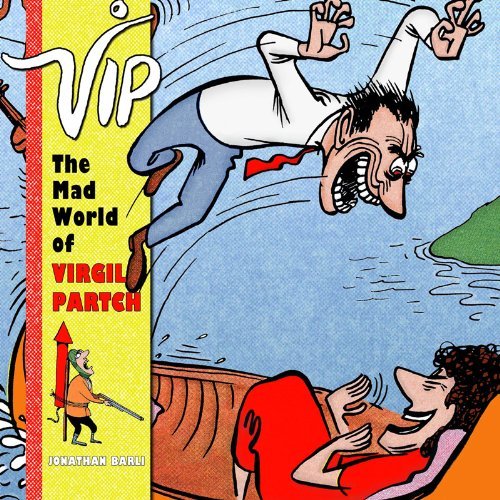
Only a few months after the devastating attack on Pearl Harbor and the same year that Albert Camus offered the world his bleak vision of man’s existence by introducing his philosophical dictum of The Absurd, Virgil Partch burst onto the scene with his own twist on the phrase. Partch was a cartoonist who offered comic counterpoint to the grim headlines and a unique perspective on human nature in the pages of the nation’s most popular magazines.
Known to millions by his jazzy signature, VIP, this comic genius ushered in a new era of the gag cartoon — zany, sometimes surreal, always hilarious — that inspired a generation of fellow cartoonists starting in the 1940s and ’50s. His madcap style of humor was reflected in the cutting-edge comedic sensibilities of Burns & Allen, Jack Benny, Ernie Kovacs, Bob & Ray, Stan Freberg, and Jean Shepherd, and would position Partch as one of the most prolific “gag-men” of his day. VIP contributed to an astonishing array of magazines, wrote gags for other cartoonists, illustrated books, album covers, and advertisements, and adorned merchandise including, appropriately, cocktail glasses.
VIP: The Mad World of Virgil Partch [hardcover, 240 pages] is the first time Partch’s life and career has been treated in full, collecting amazing artwork from the entire range of his inspired career — reprinted from original art, primary-source publications, and collectors’ and family archives — and featuring his own writings. VIP’s place in the world of cartooning and humor can finally be fully appreciated in this beautiful coffee-table volume.
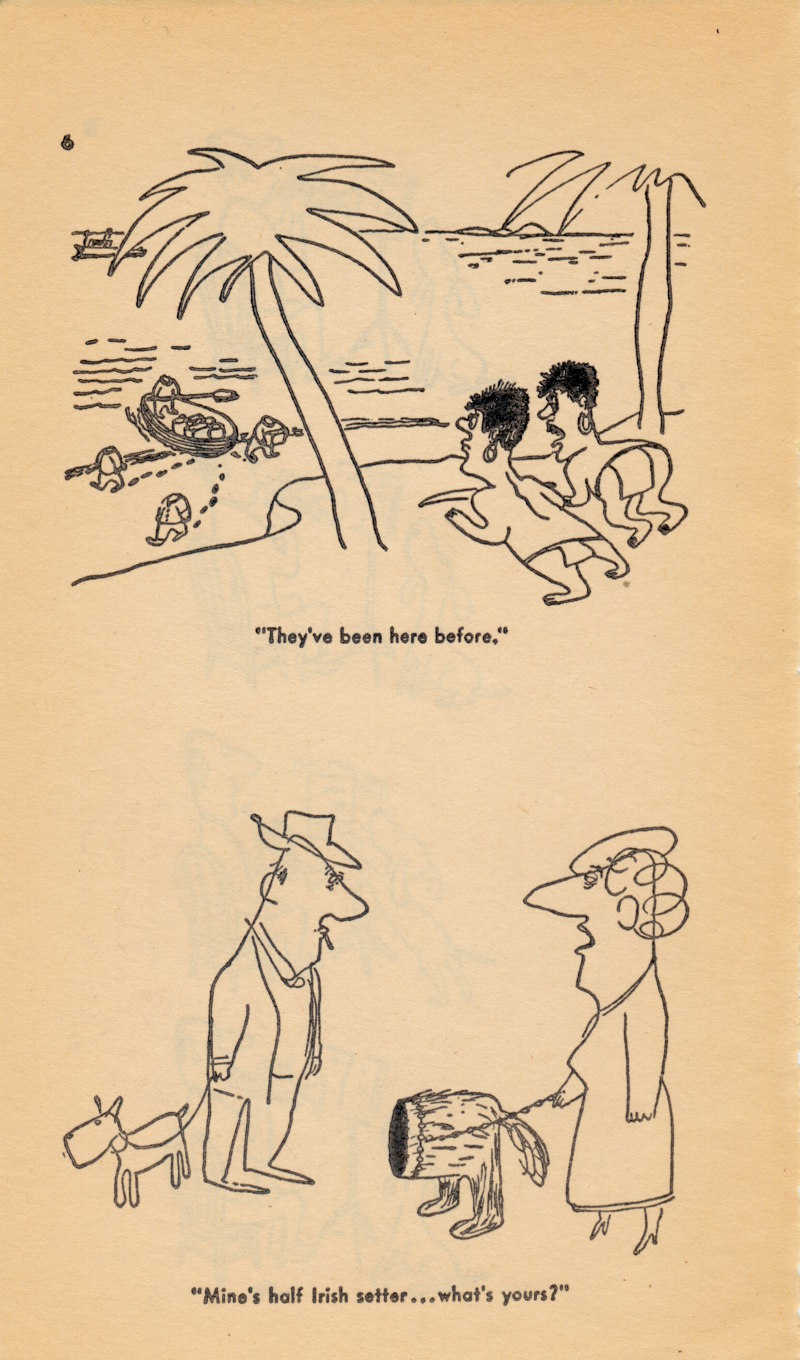
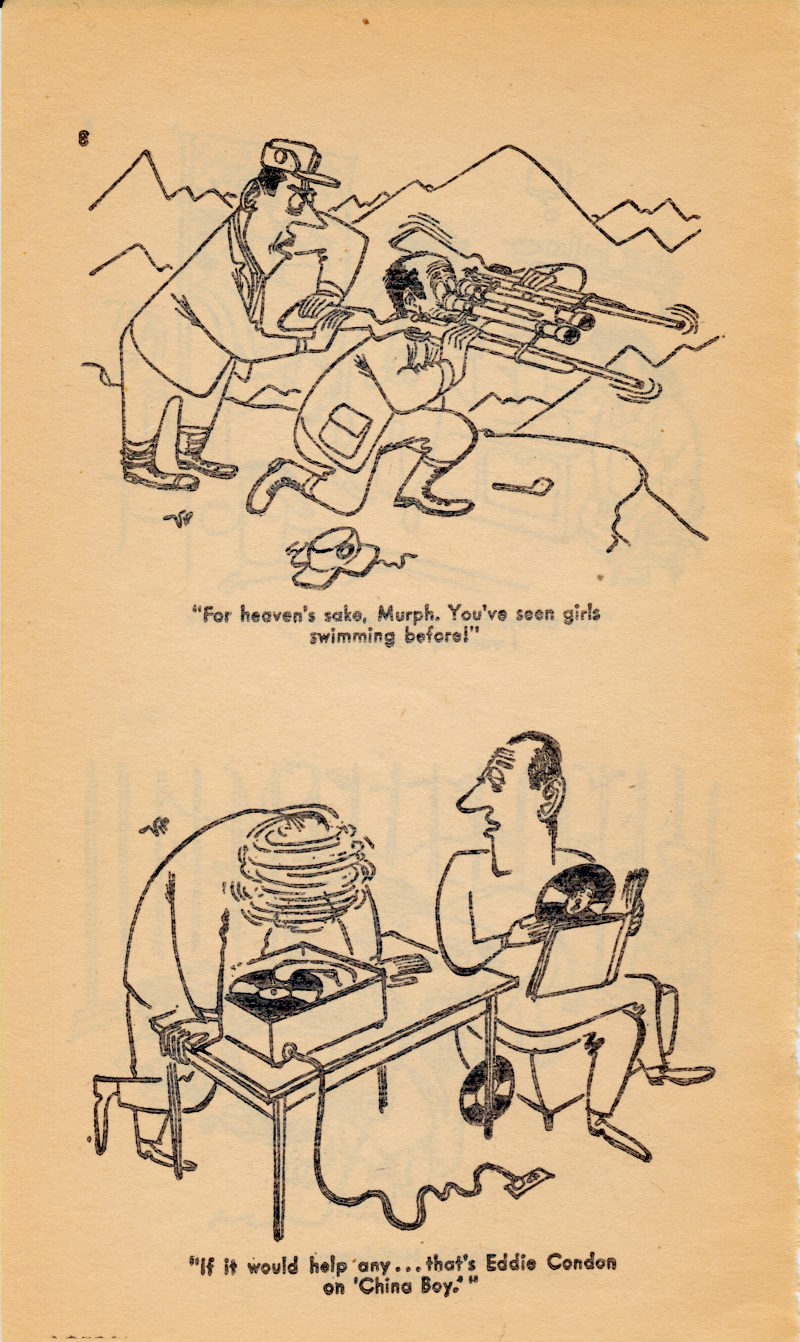
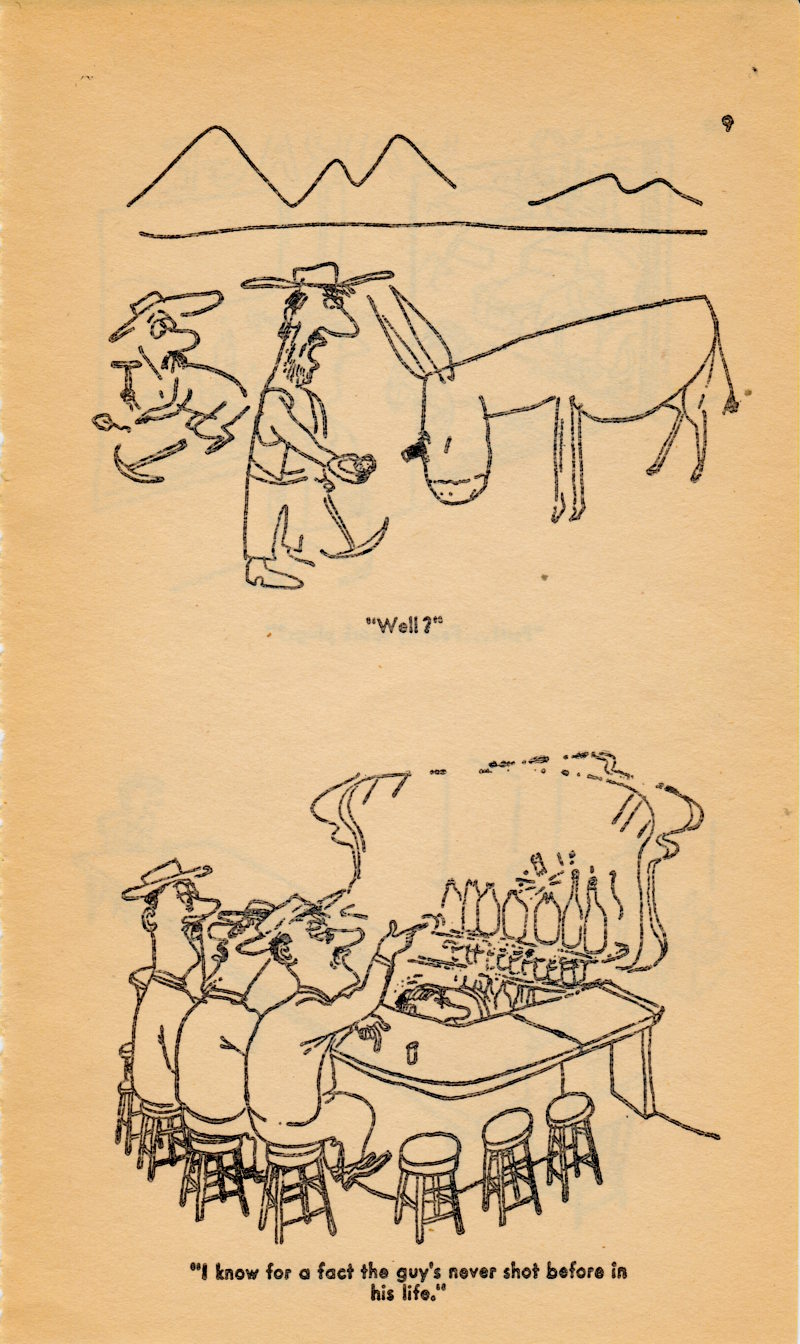
It’s easy to find work by Virgil Partch on the web; he seems to be every nerd and geek’s favourite gag cartoonist (along with Gahan Wilson). But to save you a few clicks — especially those of you who have been living under a rock and have never seen Partch’s work before — I’ve decided to scan and post the cover and the first six pages from the 1955 collection, Funny Cartoons by VIP (Greenwich, Conn.: Fawcett,1955); you’ll find the JPEGs below, along with a shockingly conventional colour gag cartoon by Partch that was published in 1967:
[CLICK IMAGES TO ENLARGE]
Ah, who am I kidding? Now that I’ve whet your appetite, you’re definitely going to want to search Google images for more Partch gold.










 Ragged Claws Network