Book/Magazine Covers (All) · Book/Magazine Covers (Jones) · Illustration Art · Jeffrey "Jeff" Catherine Jones · Look Here

Look Here: Three “Zanthar” paperbacks, with cover art by Jeffrey Jones

There were four books in the “Zanthar” series by Robert Moore Williams — Zanthar of the Many Worlds (1967), Zanthar at the Edge of Never (1968), Zanthar at Moon’s Madness (1968) and Zanthar at Trip’s End (1969) — but as far as I can determine, only the first, third, and fourth volumes had cover art by Jeffrey Jones. I’ve posted two of Jones’s “Zanthar” covers previously on RCN at a smaller size; now here are all three covers, re-scanned where necessary, and displayed in order of publication:

[CLICK IMAGES TO ENLARGE]

Keywords: Zanthar of the Many Worlds, Zanthar at Moon’s Madness, Zanthar at Trip’s End.

Art Collection · Comics · Ebay Win · Here, Read · Mell Lazarus

Look Here: More original art by Mell Lazarus

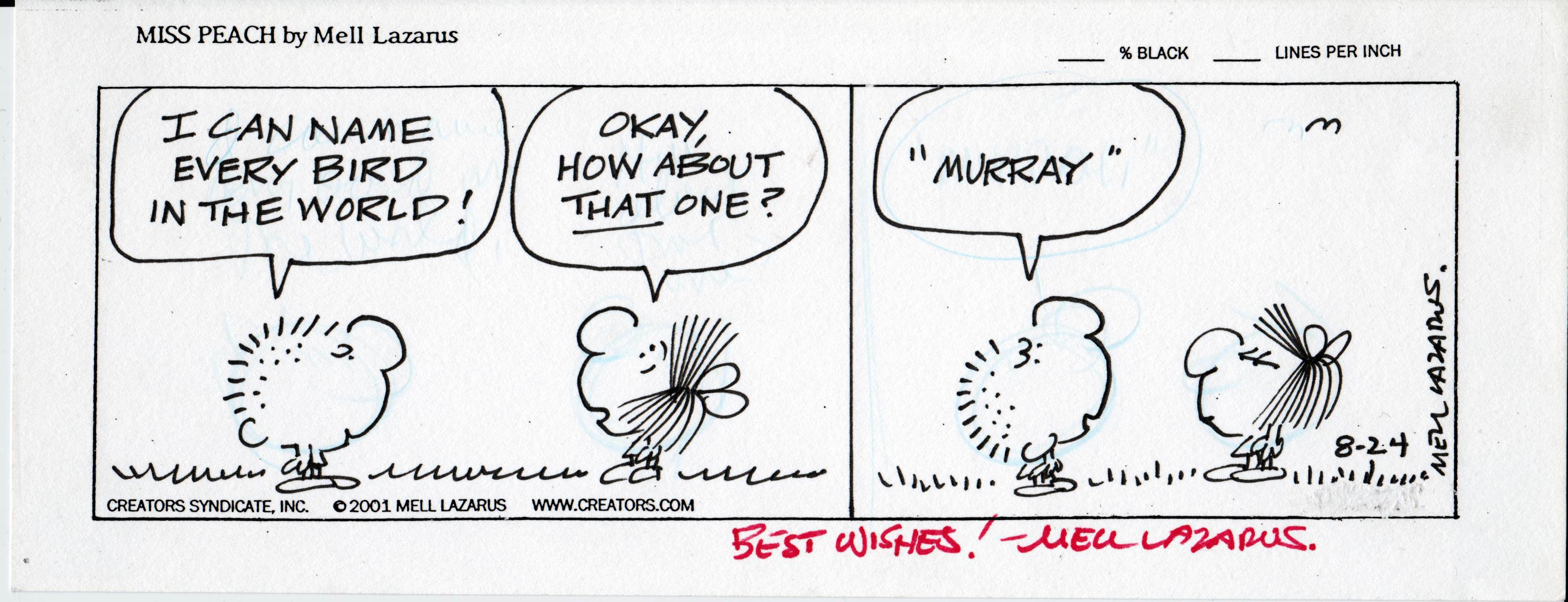
From our curious collection of comic art, old and new, here are a pair of scans of the original art for two comic strips by Mell Lazarus, “Miss Peach” and “Momma”; both strips are dated 8-24-2001, and both have been personalized by the artist with a greeting and signature in red marking pen:

[CLICK IMAGES TO ENLARGE]

If you are a fan of Mell Lazarus’s work, but have never seen his originals in person, you might be interested to know that the strips from 2001 are drawn on lightweight sheets of paper trimmed to a mere 11 inches wide by 4.25 inches high while the strips from 1958 and 1961 are on much heavier sheets that are a whopping 18.5 by 6.06 inches!

If you take a close look at the scans of original “Miss Peach” art from 1958 that I posted previously, you’ll see that Mell used pre-printed templates for his strips right from the beginning of his career as a syndicated cartoonist — and that he was frugal enough not to throw out old template sheets if they could be edited with a bit of tape and a few small paste-ups to reflect ongoing changes in the layout of the title, author credit, and so on.

Likewise, if you click to enlarge the scans posted above, you’ll find that both strips — which Mell drew some forty-four years after “Miss Peach” debuted in 1957 — are drawn on pre-printed templates that include the name of the strip and the author’s name, the syndicate name and Web address, the author’s copyright notice, an empty box in proportion to the size of the finished art, and underlined spaces — unused — for the specification of “% BLACK” and “LINES PER INCH.”

My guess is that Mell moved to the smaller size and lighter weight paper in part because he appreciated the convenience of being able to create custom templates for his strips that he could edit at any time and output on a standard home printer and in part because, at some point, as the Internet revolution took hold, he needed to be able to scan his artwork himself — “in house,” as it were — for electronic submission to his syndicate.

At some point, Mell also ditched his dip pen and bottles of ink and began drawing with a fine-point, fiber-tipped pen or “fineliner,” e.g., a Pilot, a Micron, or some such. The 2001 originals were drawn with a fiber-tipped pen, and though I like them well enough, I have to say, if you want to add a daily or two by Mell Lazarus to your comic-art collection, you definitely will want to get hold of one of the large “Miss Peach” originals from back in the day. The drawings are confident, amusing, and expressive — fiber-tipped “archival” fineliners may be convenient and easy to control, but paired with the right kind of paper, dip-pen nibs make beautiful lines — and the gags are often laugh-out-loud funny. And if by chance you find yourself the proud owner of a “Miss Peach” Sunday strip from the 1960s (see below), you definitely will be the envy of at least one other comic-art collector: me!

As you can see here and here, Mell initially drew his daily strips — “Miss Peach” started out this way — as wide single-panel cartoons, and he clearly understood how to parcel out the characters and the dialogue to make that format work. But he was not rigidly committed to the single-panel ideal. Rather, he never hesitated to make changes to his template to allow for more precise control of the timing of his gags. In the “Miss Peach” strip posted above, for instance, Mell has divided the large pre-printed panel in two with a single inked line, thereby establishing a strong pause between the wordy setup and the one-word punchline. And in the “Momma” strip, he has gone much farther, briskly brushing whiteout over sections of the pre-printed lines to open up the second panel right the way along the bottom and at the corners of the word balloon along the top and taking a moment to establish a gutter/pause between the third and fourth panels with two hand-drawn lines and a couple of touches of whiteout. Because even though his cartoon style is simple, and has been the subject of ridicule by some, Mell has always taken seriously the craft of writing dialogue and staging interactions that make people laugh.

Mell Lazarus retired his “Miss Peach” strip in 2002, but he has continued to draw “Momma” right up to the present day. He will celebrate his 85th birthday on 03 May 2012.


BONUS SCANS:

Just for fun, here are the first five pages of “Miss Peach” strips reprinted in the paperback collection, Miss Peach of the Kelly School (New York: Tempo Books, 1972):
Book/Magazine Covers (All) · Greeting Cards · Hilda Terry · Illustration Art · Look Here

Look Here: ASK ANY GIRL, with four different covers by Hilda Terry

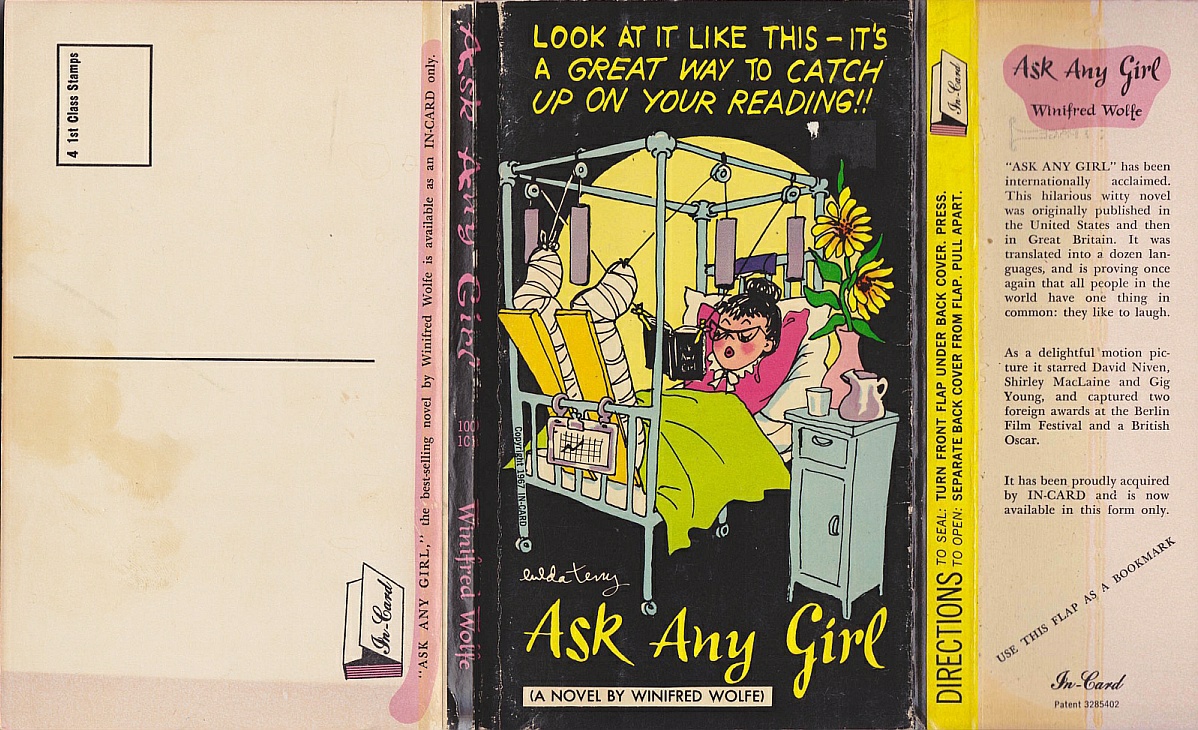
From the paperback library of yours truly, four “In-Card” paperbacks with cover art by Hilda Terry:

[CLICK IMAGES TO ENLARGE]

What’s an “In-Card”? Simply put, it’s a paperback book with a special cover that allows it to double as a greeting card and triple as a postcard. The following rough composite explains all:

I have more “In-Card” paperbacks, all with covers by Hilda Terry. So stay tuned for further “In-Card” posts… at a later date…

Ebay Win

Five items I purchased this week on eBay…

All images copied from the actual eBay listings…

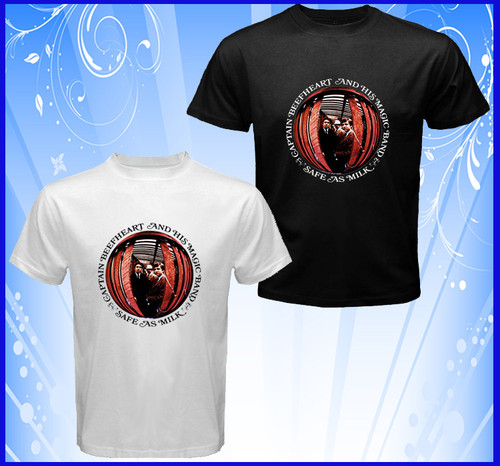
Not that anyone should care, but I got a good deal on each of the above items on eBay this week; what’s more, I purchased all four of the books from the same seller, who agreed to ship them to me all in one package for one low price. I bought Small Wonders because I don’t have it and the “Buy It Now” price was $8.99 and I’m enough of a Frazetta fan that I couldn’t resist. I bought the two paperbacks because they have covers with art by Jeffrey Jones, and yes, I will scan and post them later on RCN. I bought The Illustrated Comic Art Workshop, Vol. #2: Penciling because I ordered a copy when I was a teenager but never received the book and I’m sort of curious to see what I missed! And I bought the Captain Beefheart t-shirt because I like to buy clothes for my son that I would have loved to have worn myself at his age.


BONUS LINK:

Here’s the coolest t-shirt I ever bought for my son:

I bought the black one. Wish I were young enough to wear it myself. But middle-aged guys in graphic t-shirts always look slightly ridiculous to me. I refuse to be one of those guys.

Heads Up!

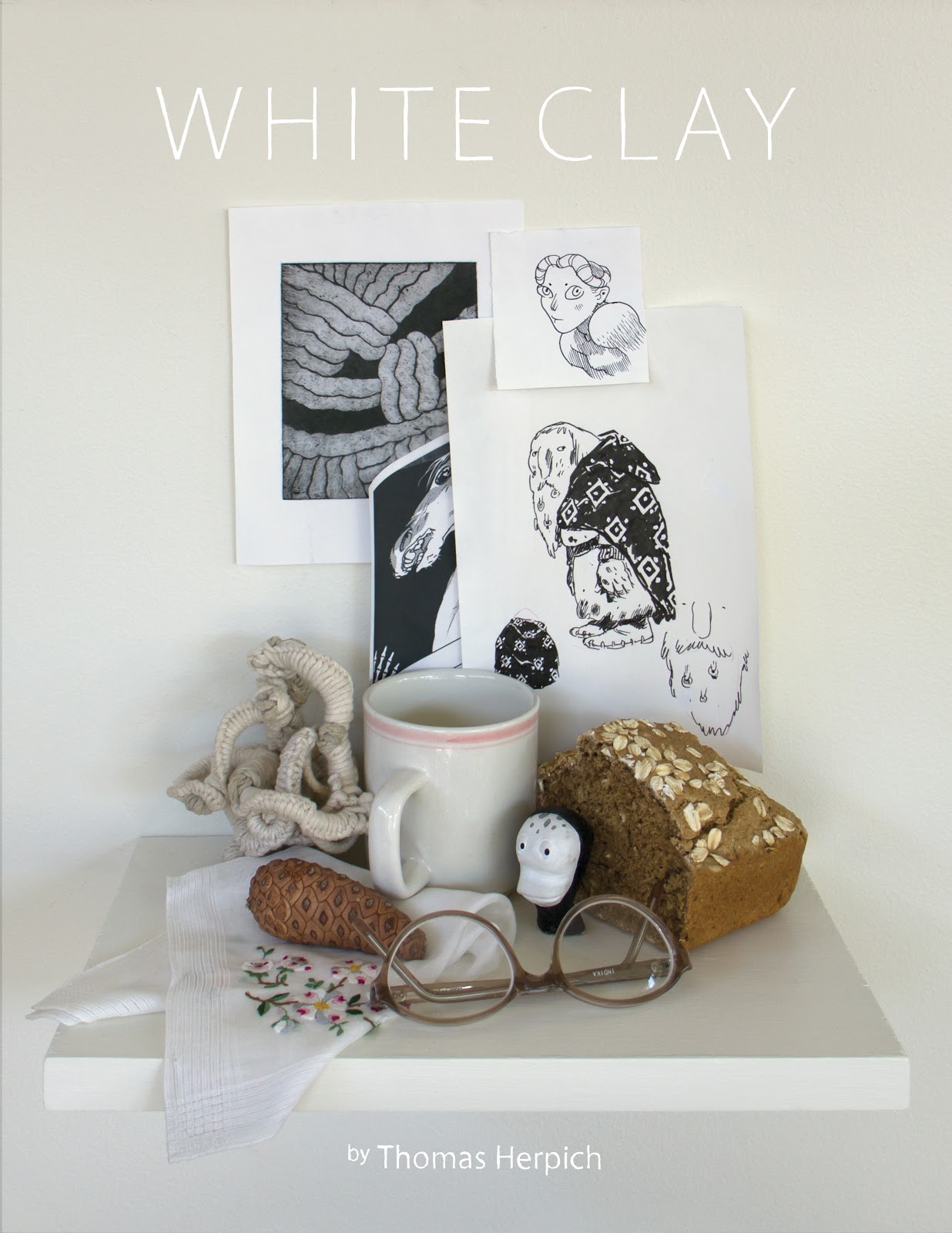
Heads Up: WHITE CLAY by Thomas Herpich

Coming in September 2012:

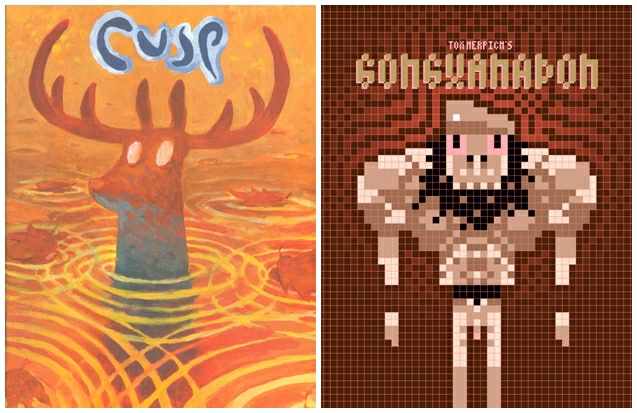
In late February, news circulated that White Clay will be Thomas Herpich’s first comics collection from AdHouse Books, but the artist has assured his fans on “Flour,” the blog he shares with his twin brother, Peter, that the new work is “definitely of a piece with Cusp and Gongwanadon,” two previous magazine-sized collections that were published by Jeff Mason’s Alternative Comics and are currently being distributed by AdHouse’s own AdDistro services.

Herpich is a terrific cartoonist, illustrator, and all-round draftsman (or draughtsman, if you prefer) whose work in comics combines visual poetry and wry humour in equal measure. I purchased both of Herpich’s previous collections when they were first published, and I have already added White Clay to my autumn 2012 shopping list.

(On a side note, it’s a pity that Herpich doesn’t sell his original artwork online, because if the price were right, I’d definitely be interested…)

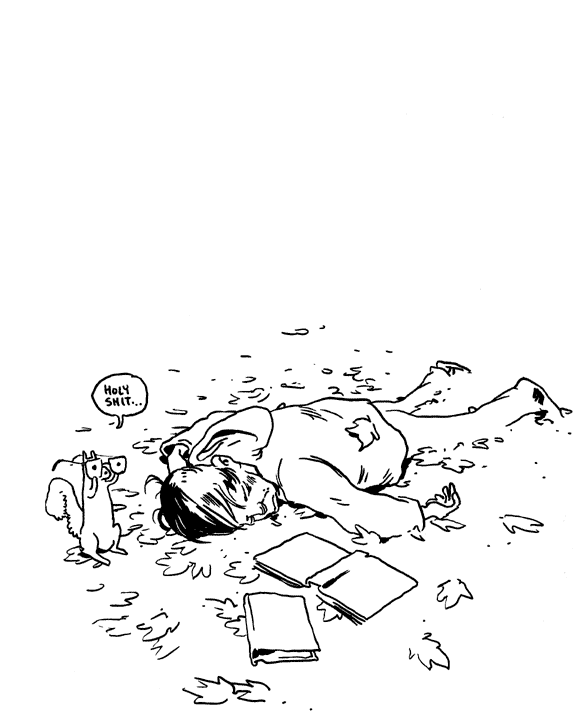
If you’d like to read some of Thomas Herpich’s comics before you buy, you should visit the artist’s website, where you’ll find a number of stories and excerpts from various publications, including Cusp and Gongwanadon. Enjoy!


BONUS LINK:

Meathaus Enterprises > Thomas Herpich — an online profile published in February 2009.

Heads Up! · Look Here

Heads Up: Water-damaged art by Eldon Dedini for sale on eBay

Right now on eBay, Lewis Wayne Gallery has the following cartoon by Eldon Dedini up for auction:

[CLICK IMAGE TO ENLARGE]

The lower half of the sheet is water damaged, but Dedini was a master cartoonist, so the image is still fun to examine up close.

(Click it and see for yourself.)

Of course, if you’re interested in purchasing the piece, the damage means that you might actually be able to secure it for a reasonable sum. At the time I am writing this post, “THIS SPACE FOR RENT” has attracted six bids, with the current bid sitting at US $105.95, although with two-and-a-half days to go until the auction closes, I predict that the final bid will be quite a bit higher.

To find the piece on eBay, simply search for “Eldon Dedini” and “THIS SPACE FOR RENT.”