Comics · Here, Read · Look Here · Wallace Wood

Look Here: “22 Panels that…”

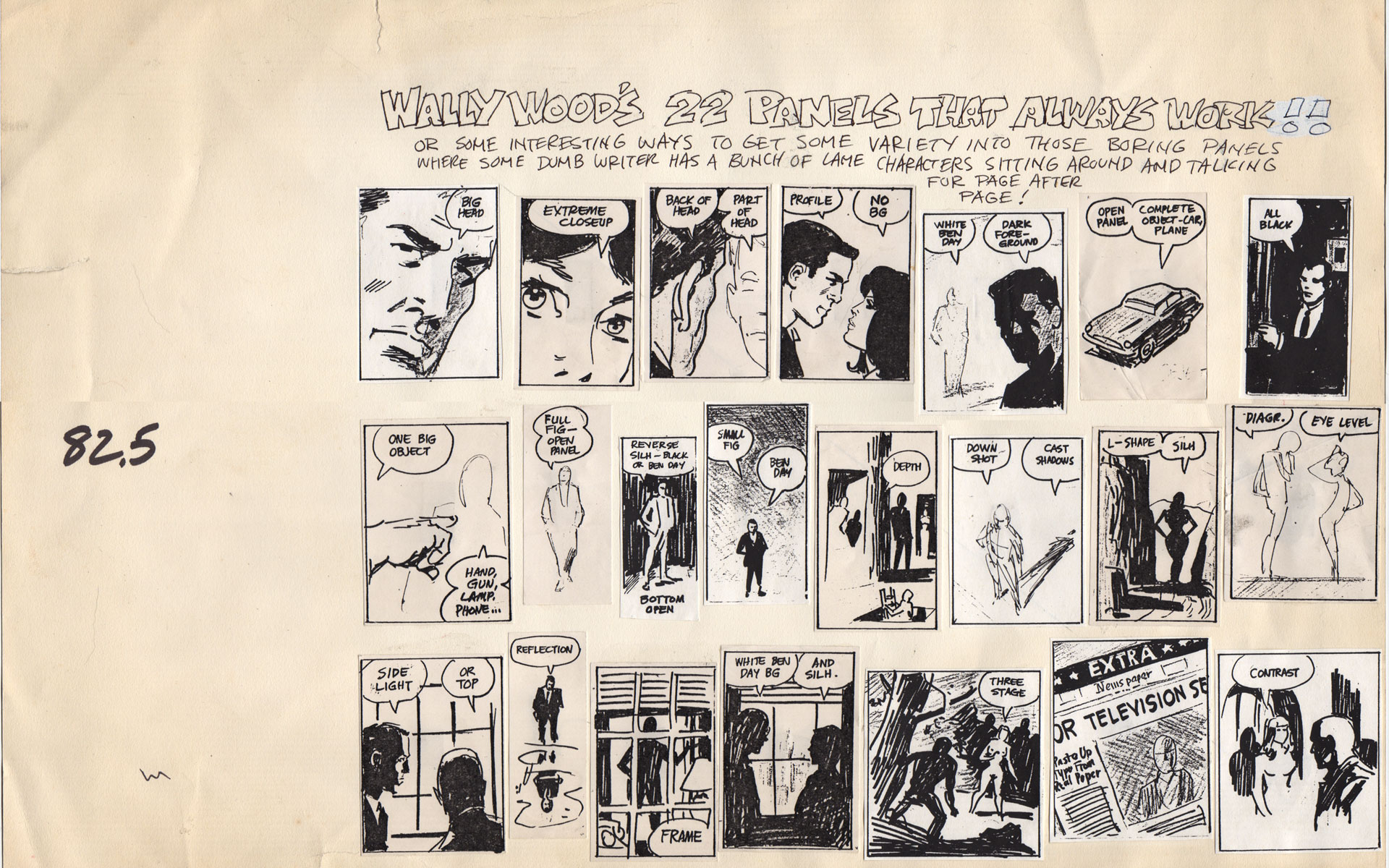
Wally Wood‘s 22 Panels That Always Work!!”:

[CLICK IMAGES TO ENLARGE]

Ivan Brunetti’s “22 Panels That Always Work* (*Sometimes)”:

Cheese‘s 22 Panels That Never Work!!”:

And…

Jon Morris’s “16 Panels That I Don’t Think Work All That Well (But Which People Keep Using Over and Over) (Also, I Couldn’t Think of 22, So Wally Wood Wins)”:

Also…

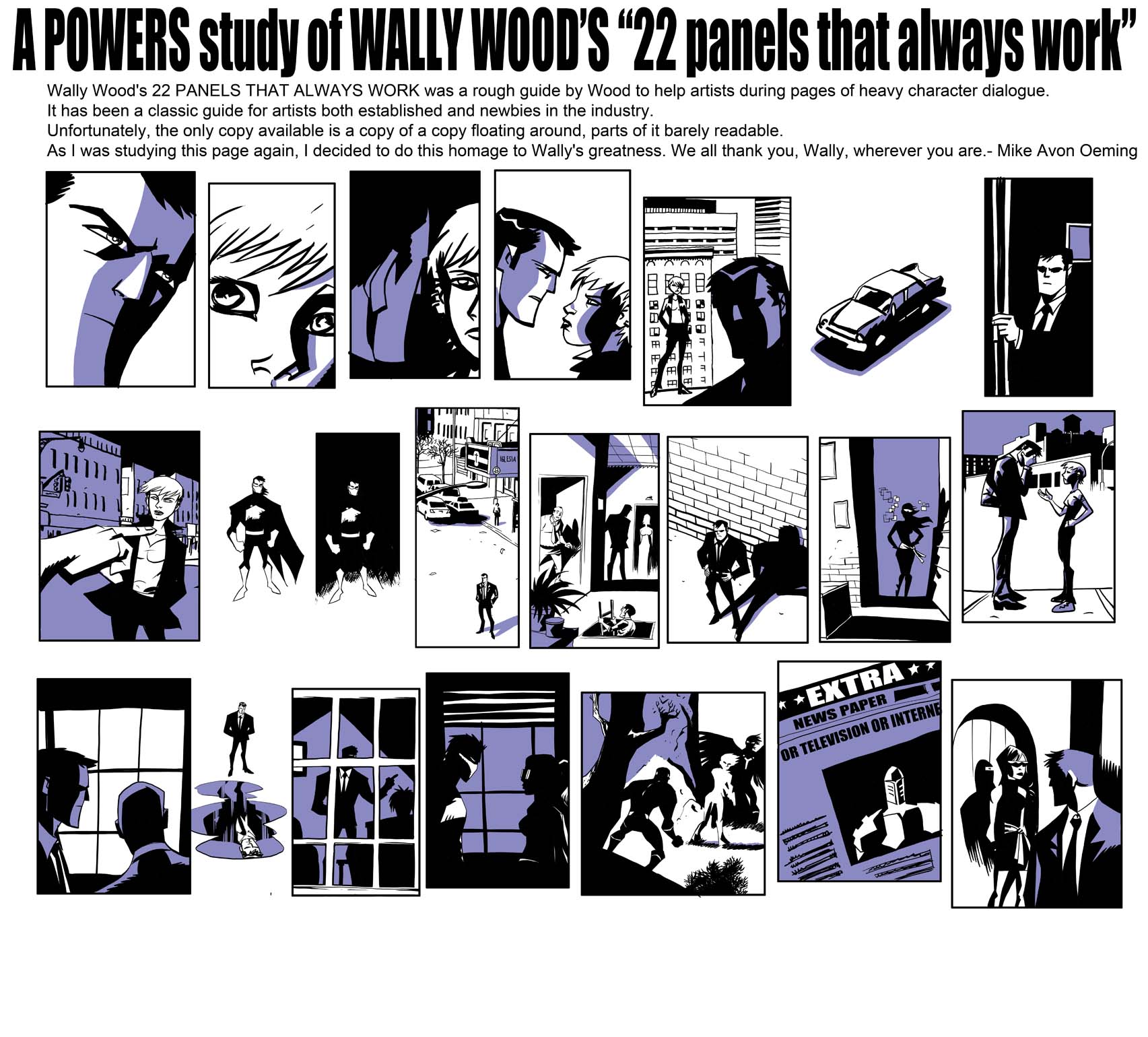
Michael Oeming’s “A Powers Study of Wally Wood’s ’22 panels that always work'”:

PLEASE NOTE that, on 04 May 2013, I updated the bonus link below to point to an Internet Archive Wayback Machine version of Joel Johnson’s post because I noticed that my link to the blog entry on Johnson’s site was dead. On the same day, I posted Joel Johnson’s various scans as bonus images in order to preserve them for posterity.


BONUS LINK:

Wally Wood’s 22 Panels that Always Work: Unlimited Edition – Joel Johnson outlines the history of the famous 22 panels and offers, for your downloading pleasure, various “high-resolution versions of ‘Wally Wood’s 22 Panels That Always Work’ in ‘Unlimited Edition,’ scanned in from the original paste-up.” Here’s an excerpt in which Larry Hama describes the genesis “22 Panels”:

I worked for Wally Wood as his assistant in the early ’70s, mostly on the Sally Forth and Cannon strips he did for the Overseas Weekly. I lettered the strips, ruled borders, swipe-o-graphed reference, penciled backgrounds and did all the other regular stuff as well as alternating with Woody on scripting Cannon and Sally Forth.

The “22 Panels” never existed as a collected single piece during Woody’s lifetime. Another ex-Wood assistant, Paul Kirchner had saved three Xeroxed sheets of the panels that would comprise the compilation. I don’t believe that Woody put the examples together as a teaching aid for his assistants, but rather as a reminder to himself. He was always trying to kick himself to put less labor into the work! He had a framed motto on the wall, “Never draw anything you can copy, never copy anything you can trace, never trace anything you can cut out and paste up.” He hung the sheets with the panels on the wall of his studio to constantly remind himself to stop what he called “noodling.”

When I was starting out as an editor at Marvel, I found myself in the position of having to coach fledgling artists on the basics of visual storytelling, and it occurred to me that the reminder sheets would help in that regard, but three eight-by-ten pieces of paper were a bit unwieldy, so I had Robby Carosella, the Marvel photostat guy at the time, make me re-sized copies of all the panels so I could fit them all on one sheet. I over-compensated for the half-inch on the height (letter paper is actually 8 1/2-by-11) so the main body of images once pasted up came a little short. I compensated for that by hand lettering the title.


BONUS IMAGES: JOEL JOHNSON’S ORIGINAL “22 PANELS” UNLIMITED EDITION SCANS

Artist Self-Portraits · Fine Art · Look Here · Max Beckmann

Look Here: Max Beckmann’s “Self-Portrait with Saxophone”

Self-Portrait with Saxophone is not only my favourite of Max Beckmann’s many self-portraits but also one of my favourite self-portrait paintings of all time. Beckmann’s painting technique, which in his later works can sometimes be a bit messy and offhanded, is beautifully controlled and economical here. The quilted (silk?) robe, which in real life would be soft but sort of slick to the touch, reminds me also of the tough protective skin of a pineapple or a pangolin, though here the underbelly, so to speak, is open and unprotected, with the casual posture, meaty hands, steady gaze, and set jaw of the artist projecting boundless confidence and creative power such that even the ordinarily rigid metallic musical instrument seems to bend and twist in conformity with the artist’s pose and grip rather than vice versa.

ABOVE: Max Beckmann, Self-Portrait with Saxophone (1930), oil on canvas, 55 1/8 x 27 3/8 in., Kunsthalle, Bremen.

Art Collection · Drawing · Ebay Win · George Woodbridge · Look Here

Ebay Win: “Mt. Arrarat Flood Victims” by George Woodbridge

As of 12 July 2008, my wife and I are the proud owners of the following artwork by cartoonist George Woodbridge:

[CLICK IMAGES TO ENLARGE]

The image area of the drawing, which first appeared in print in Mad Magazine as part of a piece entitled “Appeals from Charities through History,” is 9 x 6 inches.

The total cost, shipping included, was US$55.95.

So now we have two — count ’em, TWO — pieces by George Woodbridge in our modest but growing collection of original comic-book (and other) art.

George Woodbridge (1930-2004) joined Mad Magazine’s “usual gang of idiots” in 1957 and had work in nearly every issue thereafter. He also worked at Marvel during the 1950s on titles such as Astonishing, Battle Action, and Kid Colt.


RELATED LINKS:

Fine Art · Francis Bacon · Look Here

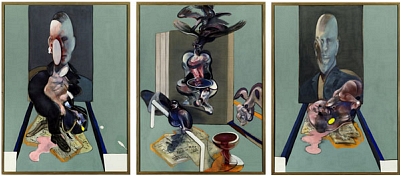
Look Here: Francis Bacon’s Triptych 1976

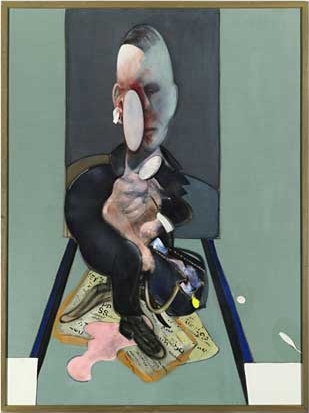
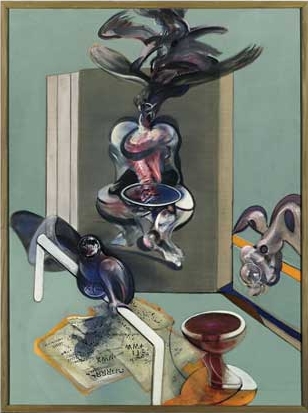
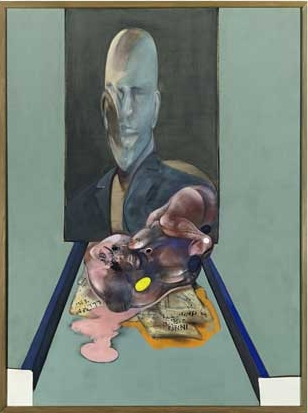
Yesterday at Sotheby’s, Francis Bacon’s masterful Triptych 1976 (oil and pastel on canvas in three parts, each 78 x 58 in., 198 x 147.5 cm., 1976) sold for US$86 million at a Sotheby’s auction of contemporary art, thereby setting a record for postwar art and contributing mightily to a record-setting total of $362 million in sales (including commission) for the event.

Who says the filthy rich have no taste?

Here’re some close-ups…

Illustration Art · Look Here

Look Here: José Miguel Covarrubias

Over at GoofButton, Jeffrey Meyer has posted some terrific scans of José Miguel Covarrubias‘s lush illustrations for W. H. Hudson’s Green Mansions. Here’s a taste (you’ll find a larger version on the GoofButton site):

What I especially appreciate about this illustration, in addition to the lovely colour and composition, is the observational quality of the foot. Although the shapes are simplified, they are still clearly based in reality, with the pinky toe tucked in toward the fourth toe, which in turn is tilted slightly toward the pinky toe, and with each of the toenails having a distinctive shape. And then there’s the pale colouration of the toes themselves, bluish near the nail, suggestive of slight downward pressure on the forest floor. And so on. Without such variations and details, the picture would still be attractive; it would not, however, be half so alive.