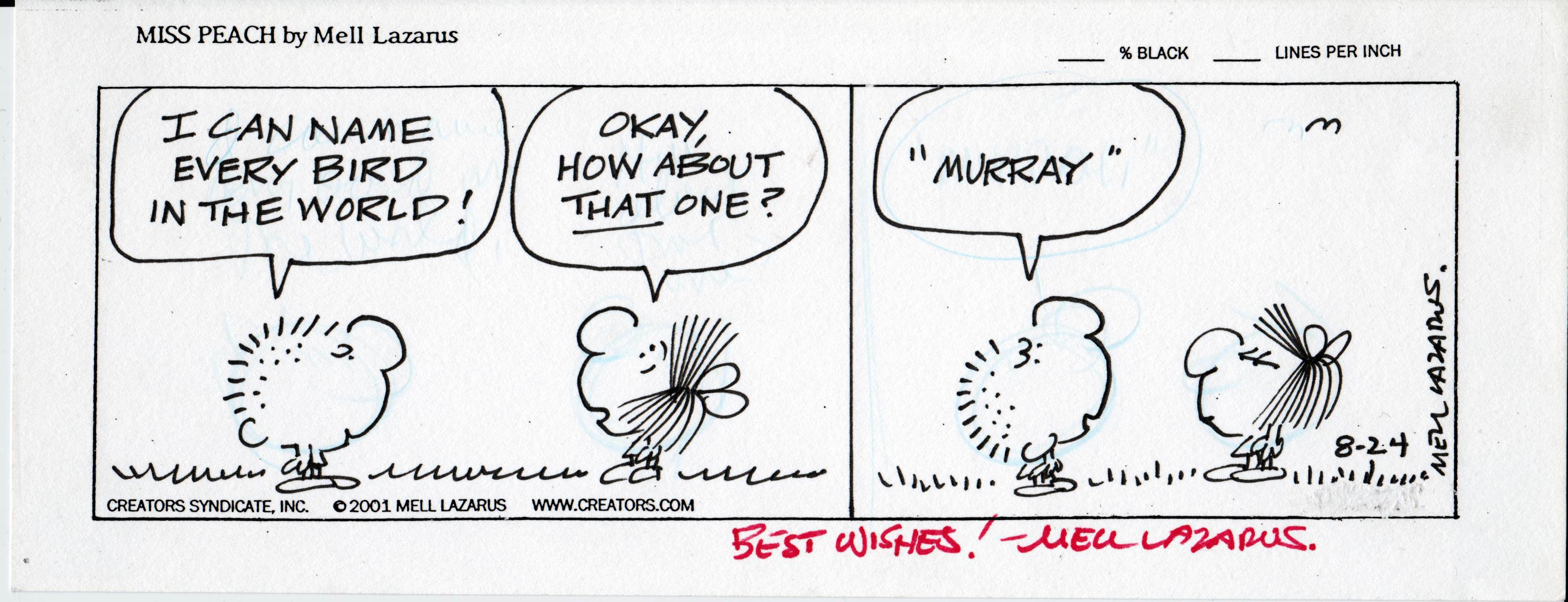
From our curious collection of comic art, old and new, here are a pair of scans of the original art for two comic strips by Mell Lazarus, “Miss Peach” and “Momma”; both strips are dated 8-24-2001, and both have been personalized by the artist with a greeting and signature in red marking pen:
[CLICK IMAGES TO ENLARGE]
If you are a fan of Mell Lazarus’s work, but have never seen his originals in person, you might be interested to know that the strips from 2001 are drawn on lightweight sheets of paper trimmed to a mere 11 inches wide by 4.25 inches high while the strips from 1958 and 1961 are on much heavier sheets that are a whopping 18.5 by 6.06 inches!
If you take a close look at the scans of original “Miss Peach” art from 1958 that I posted previously, you’ll see that Mell used pre-printed templates for his strips right from the beginning of his career as a syndicated cartoonist — and that he was frugal enough not to throw out old template sheets if they could be edited with a bit of tape and a few small paste-ups to reflect ongoing changes in the layout of the title, author credit, and so on.
Likewise, if you click to enlarge the scans posted above, you’ll find that both strips — which Mell drew some forty-four years after “Miss Peach” debuted in 1957 — are drawn on pre-printed templates that include the name of the strip and the author’s name, the syndicate name and Web address, the author’s copyright notice, an empty box in proportion to the size of the finished art, and underlined spaces — unused — for the specification of “% BLACK” and “LINES PER INCH.”
My guess is that Mell moved to the smaller size and lighter weight paper in part because he appreciated the convenience of being able to create custom templates for his strips that he could edit at any time and output on a standard home printer and in part because, at some point, as the Internet revolution took hold, he needed to be able to scan his artwork himself — “in house,” as it were — for electronic submission to his syndicate.
At some point, Mell also ditched his dip pen and bottles of ink and began drawing with a fine-point, fiber-tipped pen or “fineliner,” e.g., a Pilot, a Micron, or some such. The 2001 originals were drawn with a fiber-tipped pen, and though I like them well enough, I have to say, if you want to add a daily or two by Mell Lazarus to your comic-art collection, you definitely will want to get hold of one of the large “Miss Peach” originals from back in the day. The drawings are confident, amusing, and expressive — fiber-tipped “archival” fineliners may be convenient and easy to control, but paired with the right kind of paper, dip-pen nibs make beautiful lines — and the gags are often laugh-out-loud funny. And if by chance you find yourself the proud owner of a “Miss Peach” Sunday strip from the 1960s (see below), you definitely will be the envy of at least one other comic-art collector: me!
As you can see here and here, Mell initially drew his daily strips — “Miss Peach” started out this way — as wide single-panel cartoons, and he clearly understood how to parcel out the characters and the dialogue to make that format work. But he was not rigidly committed to the single-panel ideal. Rather, he never hesitated to make changes to his template to allow for more precise control of the timing of his gags. In the “Miss Peach” strip posted above, for instance, Mell has divided the large pre-printed panel in two with a single inked line, thereby establishing a strong pause between the wordy setup and the one-word punchline. And in the “Momma” strip, he has gone much farther, briskly brushing whiteout over sections of the pre-printed lines to open up the second panel right the way along the bottom and at the corners of the word balloon along the top and taking a moment to establish a gutter/pause between the third and fourth panels with two hand-drawn lines and a couple of touches of whiteout. Because even though his cartoon style is simple, and has been the subject of ridicule by some, Mell has always taken seriously the craft of writing dialogue and staging interactions that make people laugh.
Mell Lazarus retired his “Miss Peach” strip in 2002, but he has continued to draw “Momma” right up to the present day. He will celebrate his 85th birthday on 03 May 2012.
BONUS SCANS:
Just for fun, here are the first five pages of “Miss Peach” strips reprinted in the paperback collection, Miss Peach of the Kelly School (New York: Tempo Books, 1972):


 Ragged Claws Network


