"This day's experience, set in order, none of it left ragged or lying about, all of it gathered in like treasure and finished with, set aside." –Alice Munro, "What is Remembered"
According to The Most Complete Comicography of Richard Corben, “Duel of the Titans” was first published in the fourth issue of the venerable E.C. fanzine, Squa Tront, in 1970, and was reprinted eleven years later, in 1981, on page 25 of the only book on Richard Corben’s career and art, the long out-of-print (not to mention long out-of-date) Flights into Fantasy.
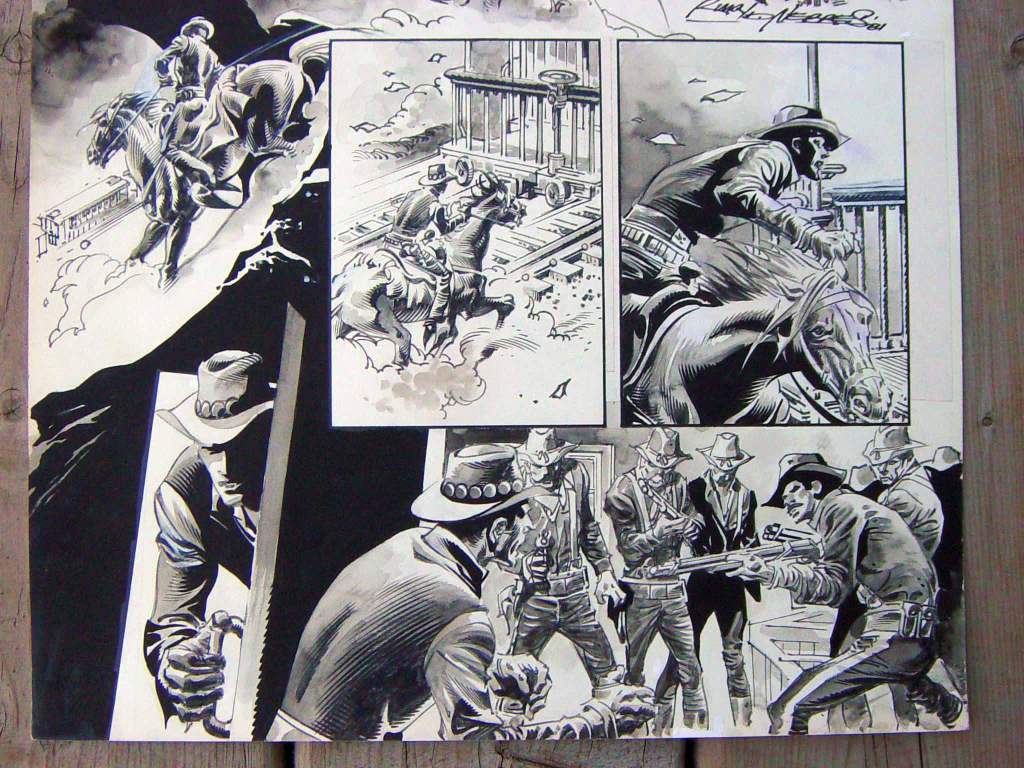
My wife and I purchased the following magnificent page by Filipino artist Rudy Nebres earlier this year:
From the early 1970s to the present day, Rudy Nebres has worked, sometimes as a penciller, sometimes as an inker, and sometimes as both (see above), on comics of all kinds, including “adult”-themed comics, for a wide variety of publishers. He’s a skilled artist who has had a long and productive career, and that’s great for him! Not so great for the average, non-art-obsessed reader, however, is the fact that only a handful of the comics Nebres worked on are worth reading for any reason other than to marvel at the man’s amazing craftsmanship. It’s a pity Nebres never found the perfect project to harness his prodigious talent — if only he could have drawn nothing but Western comics! — but the same can be said for most comics artists of his generation and before who scrambled to make a living doing nothing but “work for hire.”
I don’t know which Warren comics magazine the page we now own is from; the dealer didn’t have the information. The only information he had on his site was “Rook Story p.8 Warren Art,” so it is possible this is a page from a Rook story that appeared in Eerie or one that appeared in the Rook’s solo magazine, entitled, what else, The Rook. From Wikipedia:
He [Restin Dane, the time-traveller known as “The Rook”] appeared in Eerie #82-85, 87-95, 98-105. He got his own Rook Magazine which ran 14 issues from 1979 to 1982 (after which he returned to Eerie and concluded the storyline in #132 and continued in 134 and 136). Warren Presents #2 reprints the stories from Eerie #82-85. Eerie isues #116 and 120 had stories staring his great-grandfather.
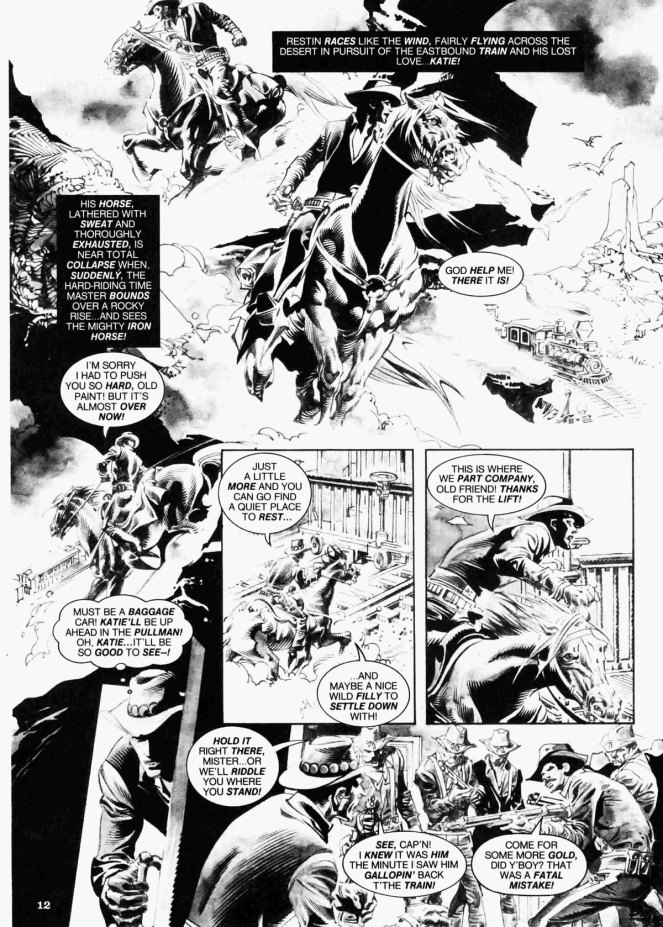
After perusing Richard Arndt’s index of Warren Magazines, I would venture to guess that the page appeared in The Rook #11 (or possibly #12). But that’s only a guess, so if you by chance recognize the page, and remember which Warren magazine and which issue the story was in, please post a comment, or send me a private message using the link at the top of the page, and let me know. I’d really appreciate the information.
p.s. If you’re wondering why there are no captions or word balloons on the page, it’s because all that is on a separate clear overlay, which thankfully came with the artwork.
UPDATE 03 OCTOBER 2008:
Acting on the basic research outlined above, I mosied on over to ebay and purchased the two issues of The Rook most likely to contain the story with our page in it. Well, the books arrived today, and I was right. Our Rudy Nebres page was printed in The Rook #11 (October 1981), page 12. The story, written by Will Richardson, is titled, simply, “The Rook.” Mystery solved!
(UPDATE [20 Janurary 2016]: Looks like that Alex Toth Gallery has disappeared. I’d delete the post entirely, except that if I did, I’d lose the nice comment below. So instead, all I’ve done is to remove the link… )
Jon Morris’s “16 Panels That I Don’t Think Work All That Well (But Which People Keep Using Over and Over) (Also, I Couldn’t Think of 22, So Wally Wood Wins)”:
PLEASE NOTE that, on 04 May 2013, I updated the bonus link below to point to an Internet Archive Wayback Machine version of Joel Johnson’s post because I noticed that my link to the blog entry on Johnson’s site was dead. On the same day, I posted Joel Johnson’s various scans as bonus images in order to preserve them for posterity.
BONUS LINK:
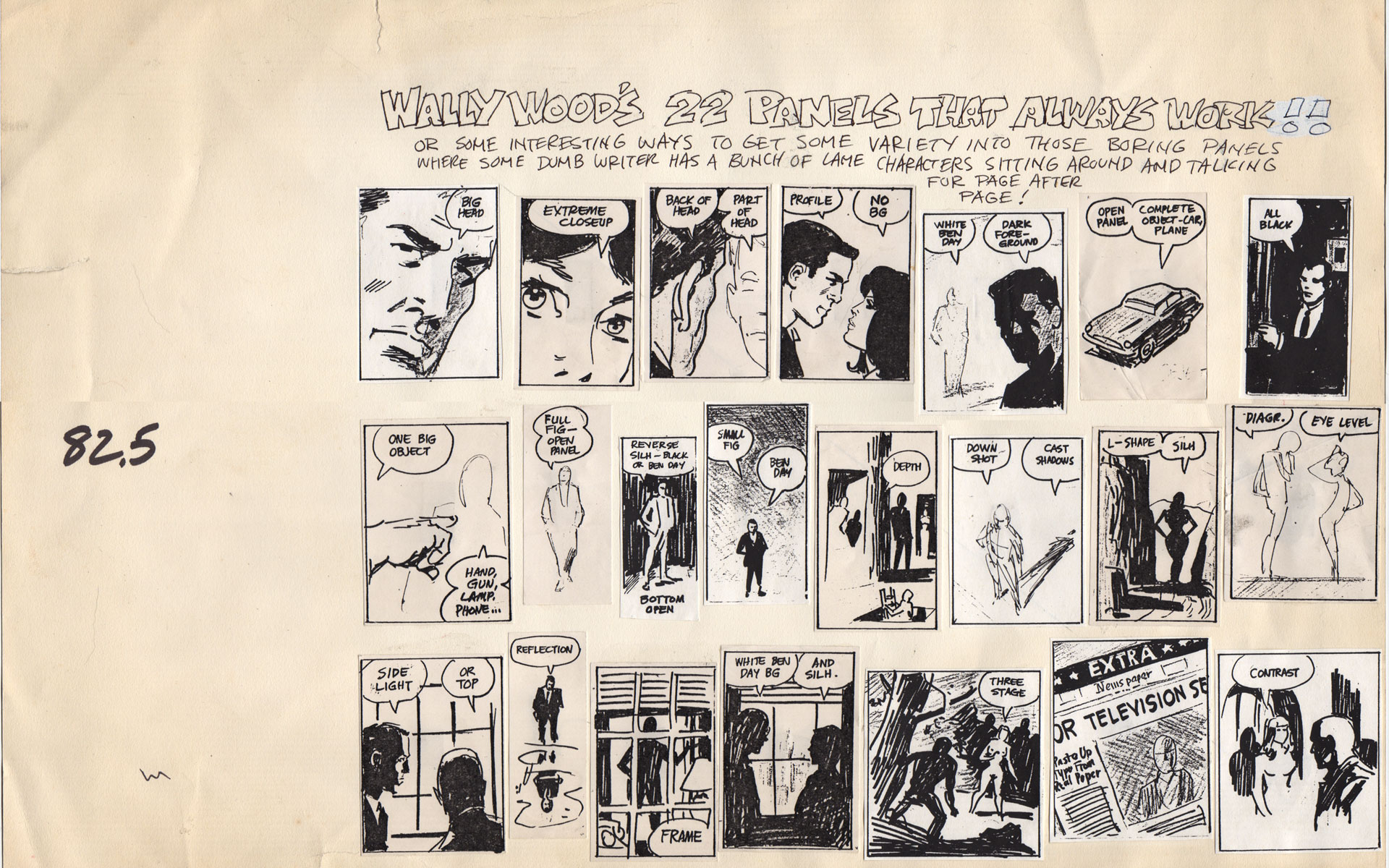
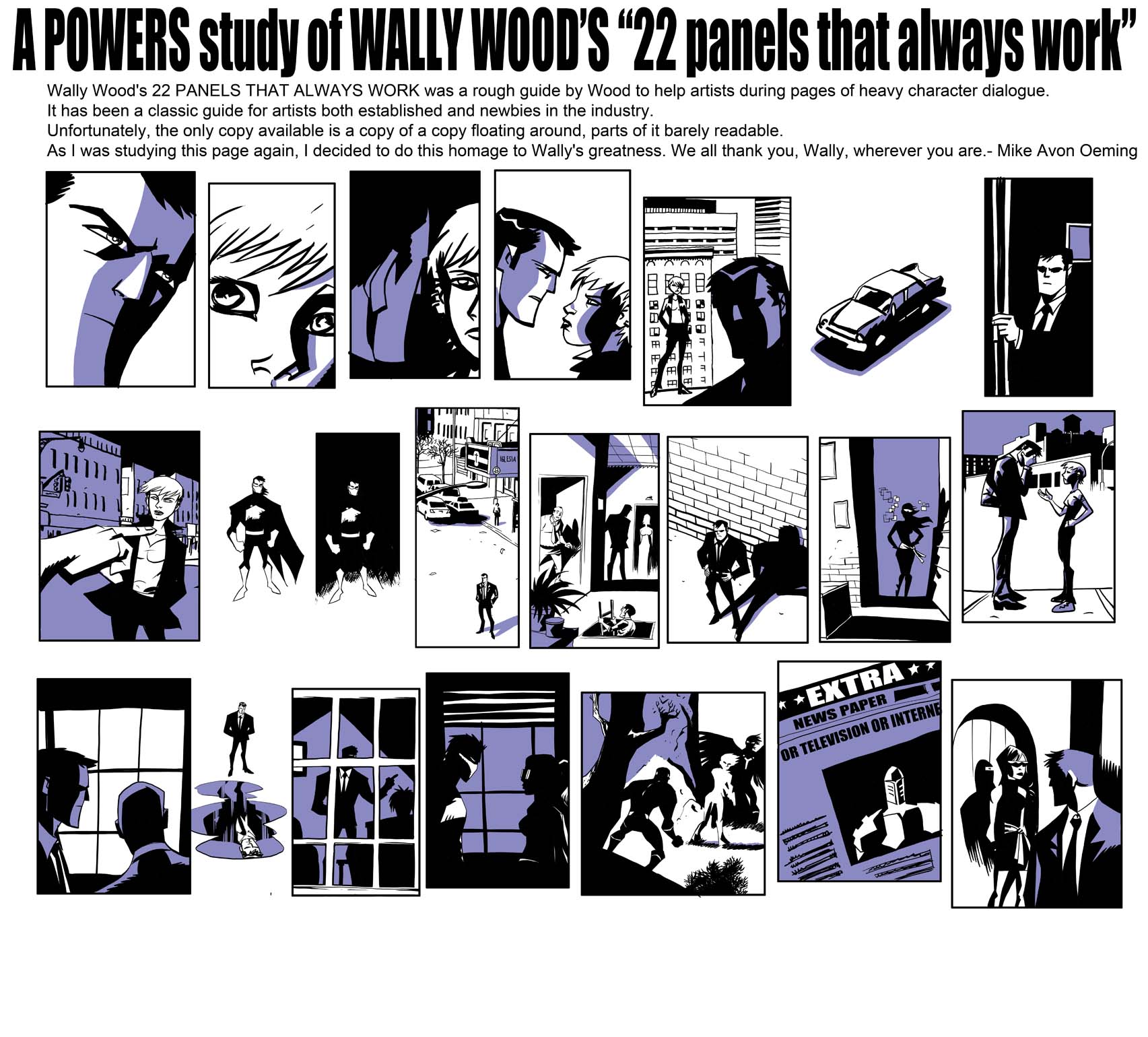
Wally Wood’s 22 Panels that Always Work: Unlimited Edition – Joel Johnson outlines the history of the famous 22 panels and offers, for your downloading pleasure, various “high-resolution versions of ‘Wally Wood’s 22 Panels That Always Work’ in ‘Unlimited Edition,’ scanned in from the original paste-up.” Here’s an excerpt in which Larry Hama describes the genesis “22 Panels”:
I worked for Wally Wood as his assistant in the early ’70s, mostly on the Sally Forth and Cannon strips he did for the Overseas Weekly. I lettered the strips, ruled borders, swipe-o-graphed reference, penciled backgrounds and did all the other regular stuff as well as alternating with Woody on scripting Cannon and Sally Forth.
The “22 Panels” never existed as a collected single piece during Woody’s lifetime. Another ex-Wood assistant, Paul Kirchner had saved three Xeroxed sheets of the panels that would comprise the compilation. I don’t believe that Woody put the examples together as a teaching aid for his assistants, but rather as a reminder to himself. He was always trying to kick himself to put less labor into the work! He had a framed motto on the wall, “Never draw anything you can copy, never copy anything you can trace, never trace anything you can cut out and paste up.” He hung the sheets with the panels on the wall of his studio to constantly remind himself to stop what he called “noodling.”
When I was starting out as an editor at Marvel, I found myself in the position of having to coach fledgling artists on the basics of visual storytelling, and it occurred to me that the reminder sheets would help in that regard, but three eight-by-ten pieces of paper were a bit unwieldy, so I had Robby Carosella, the Marvel photostat guy at the time, make me re-sized copies of all the panels so I could fit them all on one sheet. I over-compensated for the half-inch on the height (letter paper is actually 8 1/2-by-11) so the main body of images once pasted up came a little short. I compensated for that by hand lettering the title.
BONUS IMAGES: JOEL JOHNSON’S ORIGINAL “22 PANELS” UNLIMITED EDITION SCANS








 Ragged Claws Network